

The Two-Fly Rig That Covers Every April Hatch

March was simple. The water was cold, the fish were deep, and your job was to get a small nymph to the bottom and keep it there. One fly, one zone, one presentation. Easy to execute, even if it wasn't always easy to catch fish.
June will be simple again. The hatches will stabilize, dry fly fishing will dominate, and you'll tie on an Elk Hair Caddis or a PMD and fish it until dark. One fly, one zone, one presentation.
April is neither of those months. April is the crossover — the most complicated and most rewarding window of the entire trout season. Caddis are building toward their peak emergence. Blue-Winged Olives are hatching on overcast afternoons. Early stonefly nymphs are beginning their migration toward the banks. All three can be happening on the same river, on the same reach, on the same afternoon. The angler who tries to perfectly match one hatch at a time spends the whole day changing flies. The angler with the right two-fly combination on the water is already covering all three without touching their rig.
This post isn't about how to build a nymph rig — you know how to do that. It's about the four specific two-fly combinations that cover every April scenario, what each one is built for, and how to read the water to know which one to reach for first.
Why Two Flies Beat One in April
One fly forces a commitment. You pick a stage, pick a species, and present it — and if trout are focused on something different, you're wrong until you figure it out and change. In a month where three hatches overlap and fish can shift between feeding stages multiple times in an afternoon, that lag time is expensive.
Two flies cover two stages simultaneously. An anchor fly works the lower column while a trailer covers the upper column or the film. When trout transition from one stage to another — from nymphing deep to eating emergers just below the surface — your rig is already covering both. You're not behind the hatch. You're ahead of it.
There's a practical advantage beyond coverage. Every drift through a productive zone gives you information. If the anchor is getting all the eats and the trailer is being ignored, fish are feeding deep — they haven't committed to rising yet. If only the trailer is producing, they're moving up toward the film. If both flies are getting eats, you're in the overlap window and conditions are perfect. The two-fly rig is a diagnostic tool as much as a fishing tool. It tells you where in the water column trout are feeding before you can see it on the surface.
📌 Pro Tip: Tippet rings make two-fly rigging faster, cleaner, and less destructive to your leader. Attach a tippet ring to the end of your leader, tie your anchor fly on a 12–16 inch piece of tippet off the ring, and your trailer on 16–20 inches below the anchor. When you change flies you only cut and retie below the ring — your leader stays intact, your anchor stays rigged, and you're back fishing in 90 seconds instead of five minutes. Carry a dozen rings in your vest. They weigh nothing and save your leader all season.

Combination #1 — The All-Day Nymph Rig
When to reach for it: No visible surface activity. Water temperature still below 50°F. Early morning before any warming has occurred. Post-runoff clearing conditions when trout are still holding deep after a high water event.
This is your default April setup — the rig you tie on when you arrive at the water and the river isn't showing you anything yet. It covers the bottom two-thirds of the water column across three species simultaneously, requires no adjustment as conditions change throughout the morning, and will produce fish through the entire early session before any hatch activity begins.
 |
 |
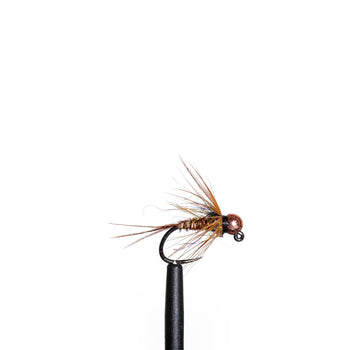 |
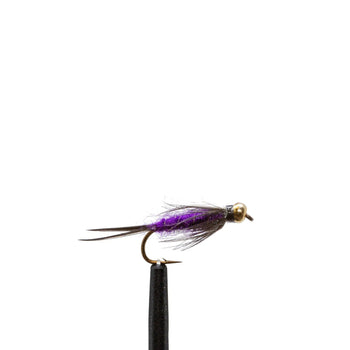
| Beadhead Purple Prince Nymph | Tungsten Bead Walt's Worm Jig | Beadhead Soft Hackle Pheasant Tail |
Anchor: Beadhead Purple Prince Nymph or Tungsten Bead Walt's Worm Jig (#12–#14) — heavy, fast-sinking, high-visibility. The Prince covers caddis larva and general attractor duty. The Walt's Worm covers caddis larva specifically with an impressionistic profile that works across a wide range of water clarity. Either choice gets you to the bottom fast and stays there.
Trailer: Beadhead Soft Hackle Pheasant Tail (#14–#16) — rides 14–18 inches behind the anchor in the mid-column. The pheasant tail body covers BWO nymphs, the soft hackle collar covers ascending caddis pupae, and the profile is slim enough to suggest early stonefly nymphs in smaller sizes. One fly covering three species at the depth where they're all active before the hatch begins.
How to Fish It
Standard indicator setup — Thingamabobber set at 1.5 times the depth of the water you're fishing. 4X fluorocarbon tippet on both flies. Work deep seams, inside bends, and moderate-current runs where fish are holding tight to the bottom. Focus on drag-free drifts with enough weight to maintain contact with the riverbed — if you're not occasionally ticking bottom, you're not deep enough.
This rig stays on until the water tells you something different. The moment you see a rise form — any rise form — consider switching to Combination #2 or #3 depending on what the rise looks like.
Combination #2 — The Dry-Dropper
When to reach for it: Sporadic surface activity beginning. Water temperature between 50–56°F. Afternoon session with occasional rise rings appearing. Overcast conditions with inconsistent hatch activity where fish are looking up but not committed to the surface.
The dry-dropper is April's most versatile rig and the one you'll fish more than any other during the overlap window. It covers two stages simultaneously — an adult or attractor dry on the surface and a pupa or emerger suspended below — which maps perfectly onto the transition period when trout are starting to look up but haven't fully committed to surface feeding.
 |
 |
 |
|
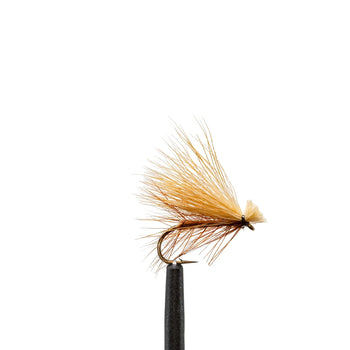
| Elk Hair Caddis | Deer Hair Sparkle Caddis | Caddis Pupa – Brown | Beadhead Soft Hackle Pheasant Tail |
Top fly: Elk Hair Caddis (#12–#14) or Deer Hair Sparkle Caddis (#14–#16) — high-floating, visible from a distance, buoyant enough to suspend the dropper without sinking. The Elk Hair covers adult caddis on the surface while doing double duty as your strike indicator for the dropper below. The Sparkle Caddis adds a trailing shuck that bridges the pupa/adult transition — a particularly effective choice when fish are still transitioning and haven't committed to eating full adults.
Dropper: Caddis Pupa – Brown or Beadhead Soft Hackle Pheasant Tail (#14–#16) — 18–24 inches below the dry fly on 5X fluorocarbon tippet. The pupa rides just below the film, imitating an ascending caddis that hasn't broken through the surface yet. The soft hackle covers caddis pupa and BWO nymph simultaneously with its versatile profile and natural movement.
How to Fish It
No indicator. Watch the dry fly. Takes on the dropper will register as the dry fly dipping below the surface, dragging sideways, or moving unnaturally against the current. Set on anything that doesn't look like a natural drift. This is where many anglers lose fish — they're watching for aggressive surface takes and miss the subtle indicator movements that signal a dropper eat.
Fish this rig through soft seams, moderate runs, and tailout water where caddis are building and BWOs are beginning to appear. Cast upstream and slightly across, mend once to extend the drift, and let the rig cover as much water as possible before the next cast.
📌 Pro Tip: Keep your dropper tippet to 5X fluorocarbon, not lighter. In April water clarity and current speed, fish can't distinguish 5X from 6X, and you need the strength to handle the combined weight of the dry fly and dropper through the cast. Drop to 6X only in very clear, very slow flat water where fish have time to inspect the tippet closely — spring creeks and tailout pools in low, clear conditions.
Combination #3 — The Emerger Rig
When to reach for it: Fish bulging or head-and-tailing just below the surface without fully breaking through. No aggressive splashing. Rise forms are subtle — a push, a roll, a quiet dimple that disappears before you're sure you saw it. BWO or caddis hatch building mid-afternoon with trout clearly active but refusing your dry fly.
This is the most specialized rig of the four and the one that solves April's most frustrating problem: fish are visibly active, you've got the right dry fly on, and nothing is eating it. The answer in almost every case is that trout are feeding on emergers just below the film — not on adults at the surface — and you need both flies in the upper six inches of the water column rather than one on the surface and one deep below it.
| |
 |
 |
 |
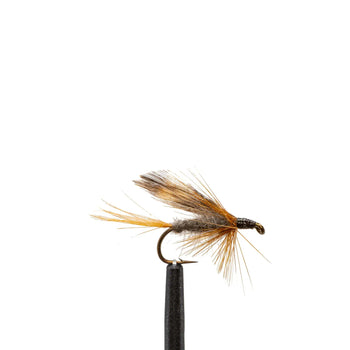
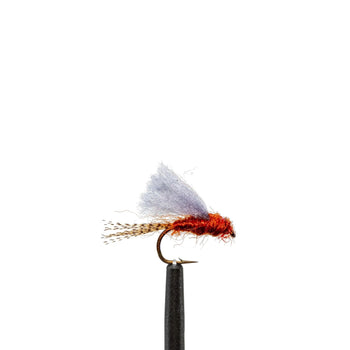
| Deer Hair Sparkle Caddis | Adams – Wet | Brown Emerger | Beadhead Soft Hackle Flash Pheasant Tail |
Top fly: Deer Hair Sparkle Caddis (#14–#16) or Adams – Wet fished as a semi-dry (#14–#16) — low-riding patterns that sit in or just below the film rather than riding high on their hackle. Fish these without floatant or with minimal floatant so they ride flush, imitating a caddis or BWO struggling in the surface film rather than a fully dried adult. The lower ride profile is exactly what fish keying on emergers are looking for.
Dropper: Brown Emerger or Beadhead Soft Hackle Flash Pheasant Tail (#14–#16) — 12–16 inches below the top fly on 5X fluorocarbon. Both flies are now fishing the upper 6–12 inches of the water column — the precise zone where fish producing bulge rises are actually feeding. The top fly covers the film, the dropper covers just below it.
How to Fish It
No indicator. Long leader — 12 feet minimum, extended to 14 feet if conditions allow. Dead drift only, no movement. These fish are eating stationary, vulnerable insects caught in the film. Any drag on your presentation will spook them immediately.
Approach from downstream, keep as much fly line off the water as possible, and present with a reach cast or pile cast to maximize drift length before drag sets in. Watch the top fly for any movement that doesn't match the current. In slow flat water where these fish are often feeding, set gently — the takes are subtle and the tippet is light.
📌 Pro Tip: If you're still getting refusals with the emerger rig in flat, slow water, check your fly size before changing patterns. Drop one hook size — from #14 to #16 — before switching to a different pattern entirely. April trout in clear, slow water are often size-selective first and pattern-selective second. A #16 Brown Emerger will frequently out-fish a #14 of the same pattern under the same conditions.
Combination #4 — The Big Bug Bottom Rig
When to reach for it: Early morning on freestone rivers. Pocket water and fast riffles with rocky substrate. High water clearing conditions. Any time you're on water where golden stoneflies or early Salmonflies are present — look for the shucks on bankside rocks as your confirmation.
April is when golden stonefly nymphs begin their annual migration from the main current toward the bank, moving through riffles and pocket water in preparation for their emergence. These are large insects — #8 to #10 — and trout in freestone rivers have been anticipating them since February. A big, heavy stonefly nymph fished through fast pocket water in April is one of the highest-percentage presentations of the entire season, and most anglers aren't fishing it because they're still thinking in terms of the small nymph setups that worked in winter.
 |
 |
 |
|
| Rootbeer Rubber Legs | Cream Soda Rubber Legs | Caddis Nymph | Tungsten Bead Walt's Worm Jig |
Anchor: Rootbeer Rubber Legs or Cream Soda Rubber Legs (#6–#8): Large profile, heavy, rubber leg movement that triggers reaction strikes in fast current. The rootbeer coloration matches the warm tan-brown tones of golden stonefly nymphs that are migrating toward the banks in April — one of the most accurate color matches available for this specific hatch window. Cream Soda offers a slightly lighter, more neutral profile that works well in clearer water or on rivers where lighter-colored stonefly species are dominant. Fish it along the bottom through fast runs and riffle water, tight to structure and close to the bank where migrating nymphs are concentrated.
Trailer: Beadhead Caddis Nymph or Tungsten Bead Walt's Worm Jig (#14–#16) — 14–18 inches behind the anchor. The trailer covers fish that are actively feeding in the stonefly zones but not specifically keyed onto the large nymph. Caddis larvae and worms are dislodged by the same fast water that stonefly nymphs are moving through, and a smaller, more natural-profile fly behind the big attractor picks up eats from fish that moved toward the anchor but committed to the trailer instead.
How to Fish It
Large Thingamabobber indicator, set deep — at least 1.5 times the water depth, often deeper in fast pocket water where the current creates a pronounced belly in the drift. 3X or 4X fluorocarbon tippet on the anchor, 4X on the trailer. You need strength to handle the weight, the current, and the hooksets that come when a trout nails a big rubber legs in fast water.
Shorten your leader and fish a tighter line than you would in slower water. In pocket water, a long cast is almost always unmanageable — you lose contact, drag sets in immediately, and the flies never reach the bottom. Stay within 15–20 feet of your target, position yourself carefully, and make precise presentations to specific zones behind rocks, along current edges, and tight to undercut banks.
📌 Pro Tip: When you find the first stonefly shucks on bankside rocks — the empty cases left behind by nymphs that have already emerged — you're in the zone. Work upstream from that point systematically, covering every piece of fast pocket water and rock-studded riffle within casting distance. Where there are shucks, there are nymphs still in the water and trout that are actively hunting them.
Reading the Water to Pick Your Rig
The four combinations above cover every April scenario. The skill is reading the water quickly when you arrive and reaching for the right one without overthinking it.
Use this as your decision framework when you get to the river:
No rises, cold water, morning or post-runoff: Start with Combination #1 — the All-Day Nymph. It covers the bottom two-thirds of the water column across all three species and requires no commitment to a specific hatch. Fish it until the water tells you something different.
Sporadic rises beginning, water warming, afternoon: Switch to Combination #2 — the Dry-Dropper. Trout are looking up but haven't committed. Cover both stages simultaneously and let the rig tell you whether the dry or the dropper is producing more eats.
Bulging rises, subtle surface activity, fish refusing your dry: Reach for Combination #3 — the Emerger Rig. Both flies go into the upper column. Long leader, dead drift, watch the top fly for movement. These are the most technical fish of the day and the most satisfying to catch.
Fast water, pocket water, freestone river, stonefly shucks on the rocks: Combination #4 — the Big Bug Bottom Rig. Get heavy, get close, get your flies to the bottom in fast current and work every piece of structure systematically.
When conditions change — and in April they will change, sometimes multiple times in an afternoon — move to the next combination. The rig transitions take less than two minutes with tippet rings in place. You'll spend more time fishing and less time rigging than any other approach.
What to Carry
Two-fly rigging doesn't require a complicated vest. Three items make all four combinations faster to build and easier to maintain throughout the day.
Tippet rings are the highest-impact, lowest-cost tool in spring fishing. A pack of 20 costs almost nothing and eliminates leader destruction from repeated fly changes. Thread one onto your leader at the start of every session and every combination in this post becomes a 90-second rig change instead of a five-minute leader rebuild. Don't fish April without them.
Fluorocarbon tippet in 4X and 5X covers every combination in this post. 4X on the anchor for strength and abrasion resistance in fast water and tungsten rigs. 5X on the trailer and dropper flies where a slimmer diameter improves the natural movement of lighter patterns in slower, clearer water. One spool of each is all you need.
Thingamabobber Standard 3-Pack gives you the right indicator for Combinations #1 and #4 — the two nymph rigs that require suspension. Carry both sizes. The larger indicator for fast water and heavy rigs, the smaller for moderate current and lighter setups. Combinations #2 and #3 don't use an indicator at all, so your indicator comes off and goes in your pocket when you switch to the dry-dropper or emerger rig.
Taking It to the Water
April doesn't reward the angler who picks one fly and commits to it for the day. It rewards the angler who reads what the river is showing them, reaches for the right combination, and adjusts when the fish tell them to. The four rigs above cover every scenario this month will throw at you — from cold morning nymphing to technical mid-afternoon emerger fishing to big bug pocket water on a freestone river.
Arrive at the water with Combination #1 already rigged. Fish it until you see something. When the first rise rings appear, identify the rise form — is it a bulge, a splash, or a head-and-tail roll? Match it to the right combination, make the switch, and get back to fishing. With tippet rings in place, that transition takes less time than it took to read this paragraph.
April is the most complicated month on the water. It's also the most rewarding. The angler who learns to move between these four rigs fluidly will cover more of the hatch, connect with more fish, and understand what's happening on the river at a level that makes every subsequent April easier than the last.
RELATED ARTICLES:
- Fly of the Month: Read the Rise — How to Decode a Caddis Hatch in Real Time
- Spring Runoff Is Coming — Here's How to Fish Through It
- Indicator Fishing Gets Easier in March
- Stop Fishing Winter Depth: How to Adjust as Trout Reposition in March
- Early Spring Fly Box Essentials: What to Carry, What to Cut, and How to Organize It


