

Spring Runoff Is Coming — Here's How to Fish Through It

Most anglers look at a blown-out river and drive past it. The water is high, the color is wrong, and the whole system feels unfishable. So they wait. They check the gauge every few days, watch the river slowly drop and clear, and eventually — sometimes weeks later — head back out when conditions look more like what they're used to.
The anglers who understand runoff don't wait. They look at the same river and see a window.
High water doesn't shut down the fishing. It reorganizes it. Fish are still there, still feeding, still catchable — but they're in different places, eating different things, and responding to different presentations than they were in February. The river hasn't shut down. It's just changed the rules, and the angler who learns those rules fishes through April instead of sitting it out.
Runoff has a rhythm. It rises and falls in response to temperature, precipitation, and snowpack — not randomly, but in predictable patterns that create fishable windows even in the heart of the worst conditions. Understanding that rhythm and knowing where to look when the windows open is the difference between a productive April and a month spent checking the gauge from your couch.
Understanding the Runoff Cycle
Snowmelt isn't constant. It's temperature-driven, which means the river fluctuates on a daily cycle that most anglers never track. Overnight cold slows the melt and stabilizes flows. Afternoon warming accelerates it, pushing a surge of cold, silty water downstream hours later. The blown-out river you saw at 2 PM on Wednesday may fish well at 7 AM on Thursday before the cycle repeats.
Understanding this means you stop thinking about runoff as a binary — fishable or not — and start thinking about it as a daily schedule with productive windows built in. The angler who checks the gauge, understands the timing, and shows up at the right moment will consistently out-fish the one who either gives up or blindly heads out at the worst time of day.
The same logic applies across a multi-day runoff event. Peak flow is followed by a gradual drop as temperatures stabilize or cool. That drop is when the real fishing happens. Sediment settles out, visibility improves, and fish that have been pushed to the margins begin moving back into feeding lies. The clearing event — that 24–72 hour window after peak flow — is the most productive stretch of the entire runoff season, and it's the one most anglers miss by staying home.
📌 Pro Tip: Check your local USGS stream gauge daily during runoff season. A falling or stable reading is your green light — fish are likely repositioning into feeding lies and conditions are improving. A rising gauge, even from a baseline that looks fishable, means conditions are deteriorating and fish will be less active. The trend matters more than the number.

Window #1 — The Early Morning Lull
The best runoff fishing of the day often happens in the two hours after first light, before afternoon warming pushes a new surge of snowmelt into the system. Overnight temperatures have slowed the melt, flows are at their lowest and most stable, and water clarity is at its best for the day. Fish that retreated to soft water during the afternoon push have had all night to settle in and resume feeding.
This window closes fast. By mid-morning, as temperatures rise and melt accelerates, clarity drops and flows begin climbing again. The angler who arrives at the river at 9 AM wondering why the fishing is slow should have been there at 6. During runoff, early is not optional — it's the entire strategy.
Fish the soft seams and inside bends during this window with weighted nymphs fished tight to structure. The fish are there, they've been feeding through the night, and a well-presented fly dropped into the right zone will find them before the daily surge muddies things up again.
Window #2 — The Clearing Event
Every multi-day runoff cycle has a clearing event — the 24–72 hour stretch after peak flow when sediment drops out and visibility climbs back to 12–18 inches or more. This is the single most productive window of the entire spring season, and it's consistently underutilized because most anglers are still waiting for the river to return to normal.
It doesn't need to return to normal to fish well. A river running two feet above average with 18 inches of visibility and a falling gauge is an excellent fishing river. Flows are still high enough to push food through the system efficiently, trout have moved back into active feeding positions, and the combination of residual high water and improving clarity creates aggressive, opportunistic feeding behavior. These are often the biggest fish days of the spring.
The clearing event is also when your fly choices matter most. Fish that have been eating whatever the current delivers in near-zero visibility are suddenly able to inspect your offering more carefully. Big, bright attractor patterns that dominated during the peak may need to give way to slightly more natural profiles as clarity improves. Watch for the transition and adjust your box accordingly.
📌 Pro Tip: When you arrive at the river during a clearing event, scoop a handful of water and hold it up to the light. If you can see your hand clearly through 12 or more inches of water, you're in a fishable window. If the water looks like weak tea, you're close — give it another few hours. If it looks like coffee, go find a tributary.
Window #3 — Tributaries and Side Channels
When the main river is blown out completely and no clearing event is imminent, turn your attention to tributaries. Smaller drainages have shorter snowmelt windows, lower sediment loads, and less overall volume — which means they clear dramatically faster than the main river. A tributary that was running chocolate on Monday is often fishable by Wednesday when the main stem is still days from clearing.
This is one of the most consistent and underappreciated tactics in spring fishing. Tributary mouths also concentrate fish during high water — trout move into the clearer, slower tributary flow and stage at the confluence where oxygenated water from the smaller stream meets the main channel. These confluence zones can hold remarkable numbers of fish during the worst runoff conditions on the main river.
Side channels off the main river operate on the same principle. They carry less volume, have slower velocity, and clear faster. They're also less pressured — most anglers walk right past them looking for the main channel. During runoff, a side channel running 8 inches of clarity while the main river is blown is not a consolation prize. It's the best fishing on the drainage.
Where to Find Fish During High Water
High water doesn't scatter trout randomly. It pushes them to predictable zones where they can hold without fighting the main current, and those zones are consistent enough that once you understand the pattern, you can find fish on unfamiliar water.
Inside bends and seams are the starting point, but the key is precision. Fish don't hold in the dead backwater of an eddy — they stage in the seam between the eddy current and the main flow, where food is being delivered efficiently without requiring them to fight current to get it. The transition line between fast and slow water is where you want your fly, not the calm center of the back eddy.
Undercut banks become premium real estate in high water. The main current has pushed closer to the bank, undercutting the soil and creating overhead cover. Fish move tight to structure for protection and to intercept food drifting along the bank edge. Your fly needs to be within 6–12 inches of the bank — not close, not nearby, right on it. Anything further out in high water is fishing the wrong water.
Tributary confluences are the highest-percentage holding zones during peak runoff. Where a tributary enters the main river, there's almost always a mixing zone with dramatically reduced velocity on the downstream side. Fish stack here to intercept food washing out of the cleaner tributary while resting in the reduced current. Fish the downstream slack at every confluence you find — even tiny feeder creeks can hold surprising numbers of fish during the worst conditions.
📌 Pro Tip: In high water, your casting distance shrinks and your footwork matters more. You're not covering broad runs — you're making precise presentations to specific zones within 15–20 feet. Move slowly along the bank, step quietly, and work each soft water zone thoroughly before moving to the next. Fish in high water are often stacked in small areas, and a sloppy approach will spook the whole pod.
Flies That Work in High, Dirty Water
High water fishing narrows the fly selection considerably, and that's actually a good thing. You don't need to carry everything — you need three categories covered and a few reliable patterns in each.
Big, bright, and visible is the first priority. In water with reduced clarity, fish are relying more on lateral line detection and contrast than on fine visual inspection. Flies that create a strong silhouette and hold their color in stained water consistently outperform natural-toned patterns. Purple is the standout color for exactly this reason — it transmits well in low-clarity conditions and doesn't exist in the natural food chain in a way that makes fish suspicious of it.
Heavy and fast-sinking is the second requirement. High flows create fast currents even in soft water zones, and a fly that drifts naturally at the right depth is far more important than pattern selection. Tungsten beadhead flies get down faster and stay in the strike zone longer. When in doubt, add weight — in high water you are almost never fishing too deep.
Worms and eggs are the third category and the one many anglers overlook out of snobbery. High water dislodges earthworms from streamside soil and carries them into the drift. It also dislodges aquatic worms, midge larvae, and early season eggs from spawning fish upstream. These are real, abundant food sources during runoff, and the San Juan Worm is not a joke fly — it's an accurate imitation of something fish are actively eating.
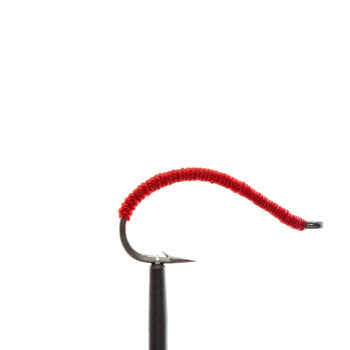 |
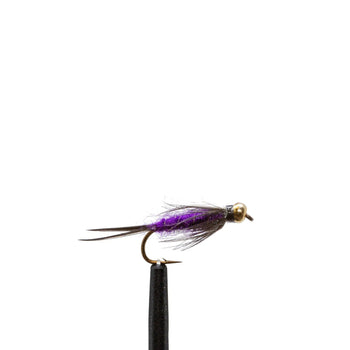 |
 |
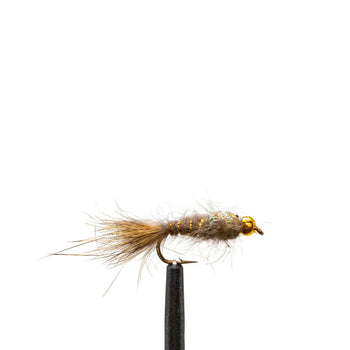 |
| San Juan Worm | Beadhead Purple Prince Nymph | Tungsten Bead Purple Perdigon Jig | Beadhead Hare's Ear Flashback |
San Juan Worm (#10–#14): The most consistently productive high water pattern in the West and arguably the most honest fly in your box — it imitates exactly what trout are eating when flows spike. High water dislodges earthworms from streamside soil and aquatic worms from the substrate, and trout eat them without hesitation. Fish it on the bottom with enough weight to stay in contact with the riverbed, or trail it 12–16 inches behind a heavier anchor fly. Red is the standard, but pink and burgundy also produce well in heavily stained water.
Beadhead Purple Prince Nymph (#10–#14): The single most effective high-visibility nymph for runoff conditions. Purple transmits contrast better than almost any other color in stained water, and the peacock herl body adds a natural shimmer that catches the attention of fish relying more on contrast than detail. The tungsten bead gets it down quickly in fast current. Fish it as your anchor fly in a two-nymph rig with a San Juan Worm or egg trailing behind. For even more flash in heavily colored water, the Beadhead Flash Purple Prince adds material that glints through murk.
Tungsten Bead Purple Perdigon Jig (#12–#16): When the water is high but starting to clear — the transition into the clearing event — the Perdigon's slim, fast-sinking profile gets you into the strike zone faster than almost any other pattern. The smooth UV resin body cuts through current efficiently and the tungsten bead provides the weight you need without the bulk. This is the fly that bridges the gap between peak runoff and clearing conditions, effective in both.
Beadhead Hare's Ear Flashback (#12–#16): As conditions clear toward the end of a runoff event, fish begin to look more carefully at what they're eating. The Hare's Ear Flashback gives you a more natural, impressionistic profile with just enough flash to remain visible in marginal clarity. Its buggy texture suggests a range of aquatic insects being dislodged by high flows. Carry it in your box as your "conditions are improving" pattern — when the San Juan Worm and Prince start getting passed up, this is usually what they want next.
For a deeper dive into purple patterns and exactly why they work in off-color water, read Why Purple Fly Patterns Work So Well in Spring Runoff.
Gear That Changes the Game in High Water
High water fishing is mobile fishing. You're not wading to the middle of a run and working it from one position — you're covering bank, moving from soft water zone to soft water zone, often on both sides of the river across multiple access points. The gear you carry needs to support that mobility while keeping everything dry. April weather in the mountains doesn't ask permission before it rains.
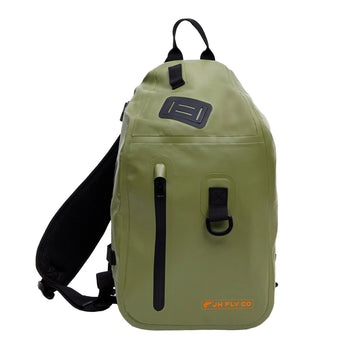 |
 |
 |
|
| JHFLYCO Waterproof Sling Pack | JHFLYCO 27L Waterproof Backpack | Fluorocarbon Tippet | Thingamabobber Indicator |
JHFLYCO Waterproof Sling Pack: The right pack for high water bank fishing. The sling design lets you swing it around to access flies and tools without removing the pack — critical when you're making frequent fly changes and moving constantly along the bank. The roll-top waterproof construction keeps everything inside dry regardless of rain, spray, or that moment you lean too far over the bank. Light enough to cover miles of water without fatigue.
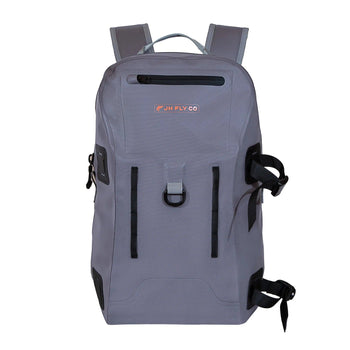
JHFLYCO 27L Waterproof Backpack: For longer days covering more water, the 27L gives you the capacity to carry everything you need without compromising on waterproofing. Extra layers, lunch, a full fly box setup, and your rain jacket all fit comfortably while staying dry. High water fishing in April is unpredictable — the conditions that were good at 7 AM can turn cold and wet by noon. Having the capacity to carry what you need means you stay on the water instead of cutting the day short.
Fluorocarbon Tippet — 3X or 4X: This is one of the most underappreciated adjustments in high water fishing. In murky conditions, fish can't see your tippet — there's no reason to go lighter than 3X, and heavier tippet handles the additional mechanical stress of tungsten rigs, split shot, and heavy indicator setups far better than 5X or 6X. You'll also lose fewer flies to break-offs on hooksets in fast current. Go heavier in dirty water. Save the light tippet for August.
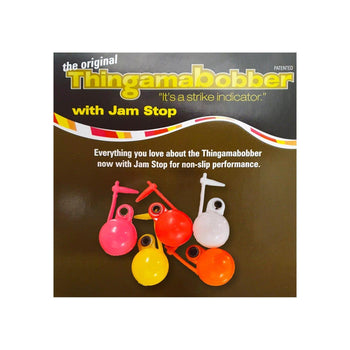
Thingamabobber Indicator: High water demands a larger, more buoyant indicator than you'd use in normal flows. The Thingamabobber's round profile generates enough resistance to suspend heavier tungsten rigs in fast current while remaining sensitive enough to detect subtle takes. Set it deeper than you think you need to — in high water the strike zone is lower in the column than you expect, and most high water nymphers are fishing 6–8 inches too shallow. If you're not occasionally ticking bottom, you're not deep enough.
Taking It to the Water
The angler who learns to read runoff doesn't wait for perfect conditions — they look for the windows within imperfect conditions. Check the gauge before you go. Identify whether you're at peak flow, in the drop, or approaching the clearing event. Choose your water accordingly — main river during the morning lull, tributaries when the main stem is blown, clearing event water when you want your best shot at the biggest fish of spring.
Work the three zones methodically: inside seams, undercut banks, tributary confluences. Keep your fly deep, your tippet heavy, and your pack on your back because you're going to cover more bank than you expect. April high water fishing isn't the fishing you planned for — it's often better.
The river hasn't shut down. It's just changed the rules. Learn them and you'll fish through April while everyone else waits for June.
RELATED ARTICLES:
- Fly of the Month: Read the Rise — How to Decode a Caddis Hatch in Real Time
- Conquer Spring Runoff: Fly Fishing Tactics That Work
- Why Purple Fly Patterns Work So Well in Spring Runoff
- Early Spring Fly Box Essentials: What to Carry, What to Cut, and How to Organize It
- Stop Fishing Winter Depth: How to Adjust as Trout Reposition in March


