

The Salmonfly Pilgrimage: Chasing the Hatch Up-elevation

There's a Wave Moving Through Your River
Most anglers fish the salmonfly hatch like a one-day event. They pick a river, watch the reports, drive in on the day the dries start showing, and fish hard for a weekend. If they hit it right, they remember it for the rest of their lives. If they miss the window — a thunderstorm, a cold front, work obligations — they wait a year.
The anglers who understand the hatch differently fish it for four to six weeks every season.
They don't pick one river. They follow a wave that moves up-elevation through the watershed as warming water releases nymphs higher into the system each week. Lower-elevation tailwaters and main-stem rivers see emergence first — sometimes in late May. Mid-elevation freestones come next, usually through mid-June. Upper-elevation tribs and headwater meadows are the last to fire, often well into early July. Anglers who chase peak weeks instead of dates fish three, four, sometimes five distinct hatch moments in the same season.
That's the pilgrimage.
It isn't a destination. It's a way of reading water that turns the salmonfly hatch from a one-week event into the better part of two months of peak dry fly fishing — if you understand how the wave moves and how to follow it.
This isn't a guide to specific rivers. We won't name your spots and we won't blow up anyone else's. The framework here works on any Western salmonfly water — your home river, your bucket list river, any system holding Pteronarcys californica or its golden-stone cousins. The principles travel. Once you understand why the hatch moves, you'll understand how to find peak water through the back half of your spring and the entire first month of summer.
Why the Hatch Moves
Stoneflies don't run on calendar dates. They run on water temperature.
When stream temperatures hit approximately 50°F — the exact threshold varies a few degrees by species and watershed — mature salmonfly nymphs begin migrating toward the banks. They crawl out of the water, split their nymphal shucks on willows and grasses and rocks, and emerge as the inch-and-a-half adults that bring trout to the surface in numbers most anglers see only a few times in their lives.
If you missed the Fly of the Month: Stoneflies breakdown, that post covers the full lifecycle and the four species that matter. The detail we need here is simpler: the hatch is keyed to water temperature, and water temperature changes by elevation.
A lower-elevation tailwater might hit 50°F in mid to late May. A mid-elevation freestone holding salmonflies might not hit that threshold until the second or third week of June. Upper-elevation tributaries draining snowpack basins might not get there until late June or early July. The same insect, the same hatch, the same fish-feeding event — staggered across six weeks of calendar time and several thousand feet of elevation.
The wave is what most anglers don't see. They fish the river they know, on the dates that worked last year, and call the hatch good or bad based on a single observation. The pilgrim understands that the river they fished last week is two weeks behind the river ten miles upstream and three thousand feet higher. The fish there are pre-hatch — hammering nymphs along the banks, getting ready for emergence. Drive another day up to the headwater tribs and the fish are still under ice melt, oblivious to anything that isn't winter food.
Three elevations. Three completely different fisheries. One hatch.

How to Map Your Own Pilgrimage
The pilgrimage isn't intuitive. It requires you to think about your river system like a meteorologist watching a weather front move across a map. The wave moves predictably once you know how to read it — but you have to know how to read it.
Here are the five tools that let you map the wave on your home water.
USGS River Gauge Data
Every meaningful Western trout river has a USGS gauge somewhere on it, and most state fish and wildlife agencies publish supplementary data for the smaller tribs. The data you care about is water temperature, updated hourly in most cases. Bookmark the gauges on your watershed. When the lower-elevation gauge climbs through 50°F, your hatch clock starts. When the mid-elevation gauge follows two weeks later, the wave has moved up.
You can track this in fifteen minutes of pre-coffee scrolling each morning. The anglers who know their water best know their gauges better than they know their weather apps.
Local Fly Shop Reports — The Gold Standard
USGS data tells you the physics. Fly shop reports tell you what's actually happening on the water. Most reputable Western fly shops update their river reports two to three times a week through hatch season, and their guides are out fishing every day. They know exactly when the dries started showing, what stage the hatch is in, and how the fish are responding.
The pilgrim's secret: read reports from multiple shops in your region, not just your home shop. The shop two valleys over sees the hatch a week earlier or a week later than yours — which is precisely the data you need to time your move up or down the watershed.
Elevation Mapping
If you don't already know the elevation profile of your home watershed, learn it. A good topographic map or any modern mapping app will show you what's at 5,000 feet versus 7,000 feet versus 8,500 feet. Mark the gauges you're tracking on this map. Mark the put-ins and take-outs you fish. Now you can see, at a glance, how the wave is going to move through your river specifically.
Two rivers an hour apart on the map can be three weeks apart on the hatch calendar if they drain different elevation bands. Once you internalize that, your fishing changes.
The 10-to-14-Day Rule
Under normal conditions — average snowpack, average spring weather, no late cold fronts — the salmonfly hatch tends to move up a watershed at roughly 10 to 14 days per major elevation band. That isn't a hard rule. Heavy snow years stretch the wave longer. Drought years compress it. A late June heat wave can push the hatch up two elevation bands in a single week.
But the 10-to-14-day rule is a reasonable planning baseline. If your home river is hatching this weekend, the next watershed up should hatch in roughly two weeks. The headwater tribs another two weeks after that.
The Pre-Trip Conversation
This one isn't a tool — it's a discipline. Call the fly shop the day before you drive. Not the week before. The day before. Hatch progressions get changed by overnight temperature swings, sudden runoff spikes, smoke from regional fires, sudden algal blooms after a heat spike, and a dozen other variables. The pilgrim doesn't commit to a river three days out — they commit the morning of, after one final phone call.
A five-minute call with a guide who fished yesterday is worth more than a week of weather forecasts and gauge data combined.
The Four Phases — and How to Fish Each One
Once you're in front of a river that's actively hatching, the question shifts from where to how. The salmonfly hatch isn't one event. It's four distinct phases, each with its own fish behavior, fly selection, and tactical approach. The pilgrim knows which phase they're in before they tie on a fly.
Phase 1 — Pre-Hatch (Water 48°F to 52°F)
The water has warmed enough that mature nymphs are beginning their migration toward the banks, but you haven't seen an adult yet. This is the most underrated phase of the hatch. Most anglers ignore it because there's nothing visible happening on the surface. The pilgrim knows that fish are conditioned to expect big meat moving along the bank lines and rocks — and they're feeding aggressively on it.
Tactical approach: Heavy nymph rigs, fished tight to the bank. Heavily-weighted patterns dead-drifted along structure. Two-fly rigs with a heavy anchor (Kaufmann's Stonefly Nymph, Mark's Stonefly, Rootbeer Yuk Bug Conehead) and a lighter trailing nymph (Beadhead Flashback Stone, Beadhead Micro Golden Stone).
Where to fish: Soft seams along the banks. Inside corners. Slow water behind structure. Big nymphs don't get out into the middle of the river — they crawl, slowly, in the slowest available water on their way to shore.
Why fish the pre-hatch: Less pressure, big fish, and you'll catch nymphs out of any salmonfly fish you bring to net — direct confirmation that you're fishing the right water. The pre-hatch is where the locals fish. The crowd shows up two weeks later when the dries start.
Phase 2 — Early Hatch (Water 52°F to 55°F, First Emergers Visible)
You'll see your first adults on the willows. You'll see one or two clumsy fluttering bugs cross the river over the course of an hour. Fish are still primarily nymphing, but they're also starting to look up. This is a transition phase — the most technical phase to fish well.
Tactical approach: Two-fly rigs with a dry on top and a stonefly nymph dropped underneath. A Black Stimulator or Vader Chubby in size 6 to 8 as the indicator dry, with a heavy stonefly nymph 18 to 24 inches below. Fish are taking the dropper most of the day and the dry on opportunistic risers.
Where to fish: Inside seams, slower water along the banks, anywhere a fluttering adult would land. Watch the willows for stonefly shucks — that's confirmation the bugs are emerging in that immediate stretch of river.
Why fish the early hatch: This is the phase where you can have great fishing without dealing with the crowds that the peak hatch brings. Smart anglers love this phase because you can fish dries and nymphs both, and the fish aren't yet hammered by other anglers.
Phase 3 — Peak Hatch (Water 55°F to 58°F, Full Emergence + Active Egg-Laying)
This is what people think of when they think "salmonfly hatch." Bugs in the air. Adults crawling on rocks and willows everywhere. Egg-laying flights at midday and late afternoon. Fish openly slamming dries. This phase usually lasts five to ten days on any given stretch of river.
Tactical approach: Big foam dries. Vader Chubby, Bird's Stone, Black Stimulator, Royal Chubby — the patterns you've been carrying all year for this exact moment. Cast tight to the banks, into back eddies, into any slow water where a fluttering adult would land. Fish them dead-drift or with the occasional twitch to mimic a struggling adult.
Where to fish: Banks. Tight to the banks. The classic salmonfly mistake is fishing the middle of the river — that's where the dead bugs end up, but not where the active feeding happens. Fish are in two feet of water along the banks, looking up at the willows. Cast within six inches of the bank and let it drift.
Why this phase matters: This is the dry fly fishing every Western angler builds their year around. It's worth driving for. It's worth taking vacation days for. But it's also where the pilgrim's discipline matters most — because peak hatch is when the crowds show up. The pilgrim follows the wave a half-day upstream into less-fished water and fishes the peak hatch in solitude while everyone else fights for the famous riffles.
Phase 4 — Late Hatch (Water 58°F+, Egg-Laying Flights Tapering)
The big bugs are mostly done. You'll still see a few adults crawling on willows, and you'll see occasional egg-laying flights, but the density has thinned. Fish have been hammered with foam for two weeks and they're getting selective. Most anglers leave the river at this point and consider the hatch over.
The pilgrim stays one more day.
Tactical approach: Smaller, more realistic patterns. Black Stimulator in size 10 or 12 instead of size 6. Tan Chubby or Royal Chubby in size 10. Realistic profile dries (Golden Stone, classic adult patterns) for picky fish. Cripple and emerger patterns for the few remaining bugs.
Where to fish: Back eddies, glassy seams, and slower water. Fish that have been pounded by foam for two weeks lose enthusiasm for the same big silhouette they were attacking last week. They'll still eat — but they'll eat smaller, more natural-looking patterns presented in slower, more deliberate water.
Why fish the late hatch: No crowds. Selective fish that test your skills. And you're now perfectly positioned to drive up to the next elevation band and find the peak hatch starting on a different river. The late hatch on one river is the early hatch on another — that's the pilgrimage in motion.

What to Carry on Pilgrimage
The fly selection for a six-week salmonfly pilgrimage isn't about quantity — it's about coverage. You need patterns that work across phases, across rivers, and across the variations in fish behavior you'll see from pre-hatch to late hatch.
Here's the core selection.
Heavy Anchors (Pre-Hatch and Early Phase Nymph Fishing)
These are the patterns you fish along the banks before the dries start, and as the dropper under your dry once the hatch begins. Weighted, realistic, and built to get down to the rocks.
 |
 |
 |
 |
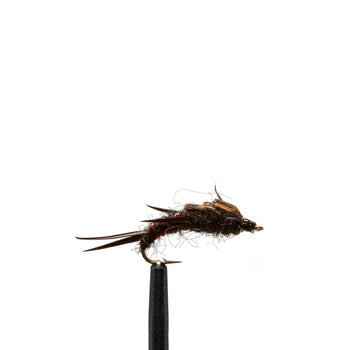
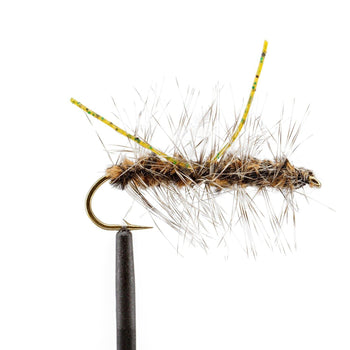
| Kaufmann's Stonefly Nymph – Black | Mark's Stonefly – Brown | Rootbeer Yuk Bug Conehead | Beadhead Flashback Stonefly – Black |
Kaufmann's Stonefly Nymph – Black (#6–#8): The classic realistic salmonfly nymph. Segmented body, biot tails, and a weighted underbody that gets to the rocks where mature nymphs live. The Western standard for pre-hatch banks fishing.
Mark's Stonefly – Brown (#6–#8): A modern realistic golden stone with a soft hackle collar that pulses naturally in the current. Particularly effective when fish get selective during the pre-hatch transition window.
Rootbeer Yuk Bug Conehead (#6–#8): The dual-purpose searching nymph that fishes equally well for salmonfly and golden stone water. Conehead drops it deep, flash collar adds attraction in stained flows.
Beadhead Flashback Stonefly – Black (#8–#10): Adds a flashback wingcase to the standard black stonefly silhouette. Catches light, triggers strikes, and gets down fast in slightly off-color water.
Mid-Weight and Realistic Nymphs (Transitional / Dropper Patterns)
The patterns you fish as a second fly behind a heavier anchor, or as a stand-alone when you want a lighter profile.
 |
 |
 |
| Beadhead Micro Golden Stone | Southfork Stone | Beadhead Pheasant Tail |
Beadhead Micro Golden Stone (#10): The smaller, lighter golden stone option for the transitional phase and dropper rigs. Perfect as a second fly behind a heavier anchor or as a trailer below a foam dry once the hatch starts.
Southfork Stone (#6–#8): A specialized nymph designed for the South Fork of the Snake and similar Western rivers. Weighted body with subtle flash makes it deadly during the transitional days between pre-hatch and peak.
Beadhead Pheasant Tail (#10–#12): In larger sizes, the Pheasant Tail doubles as a stonefly nymph imitation. Universally productive, with enough mass and natural profile to handle pre-hatch and early phase rigs.
Adult Dries (Peak Hatch and Late Hatch)
The foam and the realistic patterns that close the deal when fish are looking up.
 |
|
|
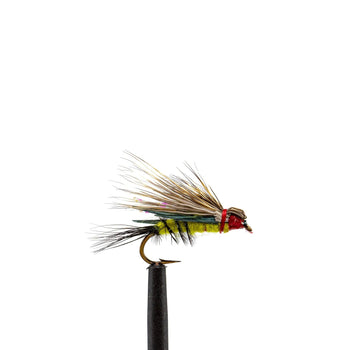 |
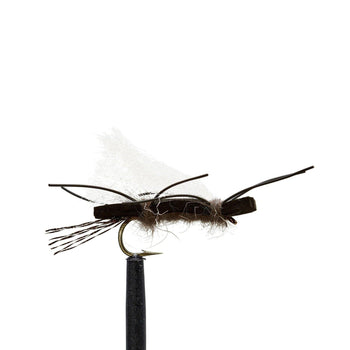
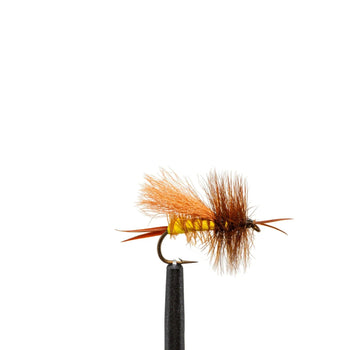
| Black Stimulator | Chubby Chernobyl – Black/Vader | Bird's Stone | Golden Stone |
Black Stimulator (#6–#12): The traditional salmonfly attractor — hair wing, palmered hackle, and a realistic adult silhouette. Versatile across phases: size 6 for peak hatch on big water, size 10 or 12 for late hatch on selective fish.
Chubby Chernobyl – Black/Vader (#6–#8): The peak-hatch workhorse. High-floating foam body, white wing for visibility, rubber legs that move on the surface. The fly most Western anglers reach for first when the dries start showing.
Bird's Stone (#6–#8): A realistic adult salmonfly with elk-hair wing and natural body coloration. Particularly effective in clearer water or slower seams where fish refuse foam patterns. The pattern for picky peak-hatch fish.
Golden Stone (#6–#8): A realistic adult golden stone dry for picky fish in slower water — back eddies, glassy seams, and spring creeks where foam attractors get refused. Essential as the hatch transitions from salmonflies to golden stones in the mid-elevations.
Or Take the Box
If you've been carrying piecemeal stonefly patterns for years and want a single curated solution that covers every phase of the pilgrimage, the JHFLYCO Stonefly Life Stages Assortment brings the entire framework into one box. Six proven nymph patterns covering both salmonfly and golden stone profiles, plus two adult dries to match the egg-laying flights when fish look up. Twenty-four flies in total, mounted in the high-visibility JHFLYCO Foam Fly Box (Orange) — built specifically to hold the larger, heavier stonefly patterns the pilgrimage demands.
It's the same lineup of patterns we'd recommend if you walked into a shop and asked for a complete salmonfly setup, packaged together at a curated assortment price. Heavy anchors for the pre-hatch nymph fishing. Mid-weight realistic patterns for the transitional phase. Adult dries for peak emergence. One box, every phase, the entire six-week season.
SHOP THE STONEFLY LIFE STAGES ASSORTMENT »
Logistics That Make the Pilgrimage Work
Knowing the framework is one thing. Living it for six weeks is another. Here are five practical disciplines that turn the theory into actual peak fishing.
Watch Your Local Shops Religiously
The shop report is your single most valuable piece of intelligence. Build a reading rhythm — every morning with coffee, every evening before bed. Track three or four shops in your region, not just the one closest to home. The shop a valley away may be reporting peak hatch while your home shop is still in pre-hatch. That's exactly the data the pilgrim uses to time their next move.
Build a Flexible Week
The single biggest mistake the salmonfly pilgrim makes is over-committing to lodging. If you book a cabin for three days on one river, you're locked to that river for three days regardless of what the hatch is doing. The pilgrim leaves their week flexible — drives in the morning of, books campsites or last-minute motels, and follows the wave wherever it's hottest that day.
If you must book ahead, book home-base lodging at an elevation band you can drive in either direction from. Mid-elevation lodging gives you the option to drop down for late hatch on one watershed or climb up for early hatch on the next.
Travel Light, Leave the Trout Setup
Salmonfly fishing is its own thing. Big flies, big tippet, big fish. Most anglers carry too much gear — they bring their full midge box, their full BWO box, their entire collection of summer dries. None of it matters during the pilgrimage.
The minimum kit: one stonefly box (or your Stonefly Life Stages Assortment), one box of attractors for slow days, a small selection of mid-summer terrestrials for the late hatch transition, and tippet from 2X to 4X. That's it. The fish are eating big flies. Don't overthink it.
The 6WT vs 7WT Debate
This question comes up every salmonfly season. The honest answer: a 6WT works for everything you'll do during the hatch, but a 7WT works better.
Big foam patterns wind-resist like a hopper. Casting a size 6 Vader Chubby into a stiff afternoon breeze on a 5WT is genuinely punishing. A 6WT handles it. A 7WT handles it easily. If you're buying a rod specifically for the salmonfly pilgrimage, go 7WT and you'll thank yourself. If you already own a 6WT, fish it without anxiety.
The Hike-In Factor
Upper-elevation tributaries and headwater meadows hold some of the best late-hatch fishing of the season — and almost no one fishes them, because they require hiking. The pilgrim earns the late hatch by walking. A two-mile hike in to a meadow stream at 8,500 feet during peak salmonfly emergence is, on the right day, the best fishing you'll do all year. The road-accessible water is fished by everyone. The hike-in water is fished by you.

Taking It to the Water
The salmonfly pilgrimage isn't about fishing more days. It's about understanding that your river is a moving system — that water temperature is the timekeeper, that elevation is the calendar, and that the anglers who understand the wave fish it longer and better than the anglers who chase a date.
This year's hatch starts in the lowest elevations of your watershed in the next few weeks. By the time the dries are gone there, they'll be peaking 1,500 feet higher in elevation. By the time they're done there, the upper tribs will be just getting started. Four to six weeks of moving, evolving, peak fishing — for an angler willing to follow the wave instead of fishing one date on one river.
Pick up your local gauge bookmarks. Build the relationships with the fly shops in your region. Build the flexible week. Carry the right patterns for every phase. And then drive — toward the wave, not away from it.
The pilgrimage is open to anyone who wants to take it. It just requires that you stop thinking about salmonflies as an event and start thinking about them as a season.
📌 Pro Tip: If you only fish one phase this year, fish the pre-hatch. The fishing is excellent, the crowds are nonexistent, and the experience of catching a 22-inch brown that's stuffed with size 4 black stonefly nymphs is the kind of thing that recalibrates how you think about big bug fishing forever.


