

Fishing the Foam Line: Why Foam Is Food and How to Read It

There's an old piece of river wisdom that gets repeated so often it's become a bumper sticker: foam is home. Like most fishing clichés, it's repeated more than it's understood. Anglers nod along, cast at some bubbles, and move on.
But the saying is worth taking seriously, because it's pointing at something real — and once you understand why foam matters, you stop seeing a river as a wall of moving water and start seeing it as a map. Foam lines are the most reliable, most readable feature on any trout stream. They tell you where the current is concentrating, where the food is going, and — if you know how to read them — exactly where the fish are sitting.
This is how to find them, why they work, and how to fish them.
Why Foam Means Food
Foam forms where currents converge. As water tumbles over rocks and through riffles, it traps air; where two currents meet and slow, that aerated water collects into the white, bubbly line you see drifting downstream. That's the mechanical explanation, and by itself it isn't very interesting.
Here's what matters: whatever the current is doing to that foam, it's doing to everything else that floats. Spent mayflies, drowned caddis, ants that fell off a branch, beetles blown off the bank, emerging nymphs riding the film — all of it gets swept into the same converging currents and funneled down the same line. The foam is simply the part you can see. It's a visible marker for an invisible conveyor belt of food.
Trout figure this out fast. A fish that sits beside a foam line gets a steady delivery of calories without moving, which is the whole game for an animal that has to eat more energy than it burns. Foam lines also break up the surface and provide overhead cover, so a trout holding there is both well-fed and hard to see from above. Food plus safety is why the best fish in a run are so often within a foot of the foam.
So when you walk up on unfamiliar water and don't know where to start — start with the foam.
Finding the Foam Line
Foam lines form anywhere currents converge, and once you're looking for them you'll see them everywhere. The most productive versions show up in a handful of predictable places.
Below riffles and rapids. The most classic foam line of all. Fast, broken water pours into a slower pool, and the aerated seam extends downstream from the riffle for anywhere from a few feet to the length of the run. The head of that seam — right where the fast water gives out — is prime.
Where two currents meet. Around an island, below a midstream boulder, at a confluence where a side channel rejoins the main river. Anywhere two flows come back together, they concentrate everything they're carrying.
Along the outside of bends. As the current sweeps around a bend, the foam gets pushed to the outside and stacks up against the bank. That's a double win — food funnel plus the deeper water and undercut bank that a big fish wants.
In back eddies and along their edges. Eddies collect foam in swirling mats. The fish generally aren't in the dead center of the mat; they're on the edge, in the seam where the eddy meets the main current and food is being delivered rather than just circling.

Where the Fish Actually Sit
This is where most anglers get it wrong. They spot a foam line, cast into the middle of the thickest, whitest foam, and wonder why nothing eats. The foam itself isn't the target — it's the indicator. The fish are almost always at the edges.
The seam beside the foam. Your highest-percentage water. Trout hold in the slower water just off the foam line and dart into the current to intercept food as it passes. Present your fly on the foam line or just to the slow side of it, and you're putting it directly in the feeding lane.
The head of the line. Where the foam first forms below a riffle, the food is arriving freshest and most concentrated. Bigger fish often claim this spot. It's turbulent enough to feel safe and rich enough to be worth defending.
Under the foam. Don't forget the third dimension. A thick foam mat gives trout genuine overhead cover, and fish will sit directly beneath it — especially in bright sun and low water, when the surface film is the closest thing to shade they can find. A dropper riding a foot or two under the foam finds these fish when a dry alone won't.
The tailout of the line. As the foam line fades into flatter water, food that's been funneled the whole way finally slows and spreads. Fish sitting here get a last, easy look — which also means they get a good look, so this is where your drift needs to be cleanest.
📌 Pro Tip: Before you cast, watch a piece of foam float the entire length of the seam. That bubble is doing exactly what your fly needs to do — it shows you the speed, the path, and every place the current pulls sideways. If your fly can't match that drift, your drift is wrong. Read the bubble first, then cast.
How to Fish It
Foam lines fish best when you treat them as a lane, not a target. The goal is to get your fly into the line at the top and let it travel the whole length without drag.
Fish it from the bottom up. Start at the tailout and work upstream. That way you're approaching fish from behind, and any fish you spook runs upstream away from water you haven't fished yet — instead of blowing out the entire run.
Get the whole drift. Cast above the head of the foam line so your fly is already drifting naturally by the time it enters the productive water. Mend as needed to keep the line off the faster current beside the seam. The most common mistake is casting straight into the middle of the line and letting drag pull the fly out within a few feet.
Fish the edges deliberately. Work the slow-water side of the seam first, then the foam itself, then the fast edge. Cover the lane in passes rather than assuming one cast down the center did the job.
Add a dropper. Because trout hold both beside and beneath foam lines, a dry-dropper is the most efficient way to cover them. The dry rides the seam where you can see it; the nymph rides in the food column underneath. If you're not sure whether fish are up or down, this answers the question in a few drifts. We broke the whole system down in our guide to dry-dropper pairings for every water type.
Flies That Work in the Foam
Two things matter when picking flies for a foam line. First, match what actually collects there — terrestrials and spent insects that fall in and can't get out. Second, and just as important: you have to be able to see your fly against white foam. A small dark dry disappears in a bubble line, and a fly you can't track is a fly you can't fish. These four solve both problems.
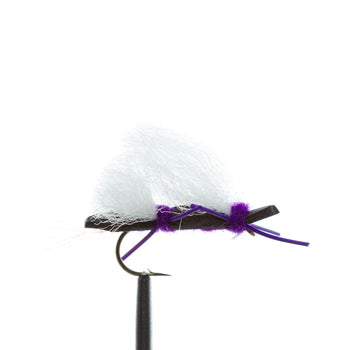

Chubby Chernobyl – Knockout (Black/Purple) (#8–12): The foam-line workhorse. Its white poly wing is the single most visible thing you can put on a bubble line, and the buoyant foam body rides high through the turbulent seam below a riffle without drowning. It's also the best dropper anchor in the box — it'll suspend a weighted nymph in the food column beneath the foam all day. If you want to learn more about fishing big foam attractors, we covered the whole category in our guide to summer foam attractors.
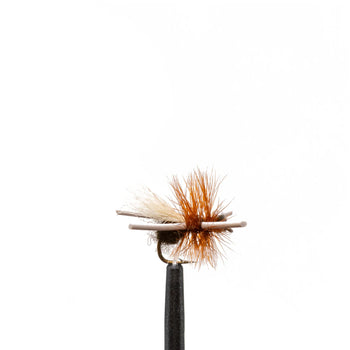
Super Ant – Black (#10–16): The most honest foam-line fly there is. Ants fall off bankside vegetation constantly through summer, get swept into converging currents, and end up exactly where the foam ends up — trapped in the film with no way out. Trout eat them with total confidence. The Super Ant's high-float construction and bigger profile keep it visible in the bubbles where a standard small ant would vanish.
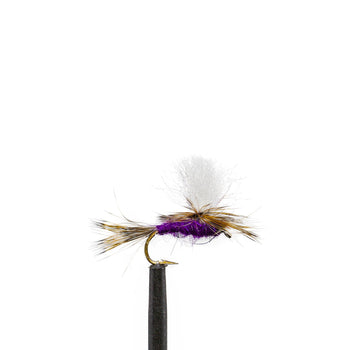
UV Para Purple Haze (#12–18): The searching dry for when a Chubby is too much fly. The purple body gives you contrast that a gray Adams can't — it reads as a distinct silhouette against white foam instead of disappearing into it — and the parachute post makes it trackable at distance. The UV sparkle worked into the body adds a dimension trout see better than we do. A deadly general mayfly imitation that happens to be built for exactly this water.
Beadhead Pheasant Tail Nymph (#14–18): The dropper. Because plenty of foam-line fish are holding under the foam rather than sipping off the top, you need something riding in the food column below. The beadhead sinks it into the zone quickly and the slim pheasant-tail profile imitates the mayfly nymphs that make up the bulk of a trout's subsurface diet. Hang it 18–24 inches below your dry and let it ride the seam.
Taking It to the Water
Foam lines are the closest thing a trout stream has to a set of instructions. They mark where the current concentrates, where the food travels, and where the fish can eat without working for it. Learning to read them turns unfamiliar water from intimidating into obvious — you can step onto a river you've never seen, find the foam, and know within a minute where to make your first cast.
So next time you're standing at the head of a run wondering where to start, don't overthink it. Find the bubbles. Watch one float the length of the seam. Then put your fly exactly where it went.
Foam is food. Fish it like you mean it.


