

The Dry-Dropper Rig: Four Pairings for Every Water Type

Trout don't feed in a single layer of water. They feed in three — the surface for hatching adults, the film for emergers and cripples, and the column for nymphs ascending or holding deep. On any given June afternoon, fish in the same run are eating in all three layers at once, switching between them based on what's most abundant in the moment.
A single dry fly covers one of those layers. Drift it through productive water and it intersects only the trout that commit to a surface eat in the window the fly drifts over — a small fraction of the active feeding population. Most of what's actually being eaten happens six to eighteen inches below the surface, where the dry fly can't reach.
The dry-dropper rig solves that. It puts a fishing fly in two columns at once — the dry on top, a nymph trailing below — and turns the dry into a strike indicator for everything happening underneath. Either fly can produce a take on the same cast. It's not a choice between dry-fly fishing and nymphing. It's both, simultaneously, with one rig.
This guide breaks down why the math favors the dropper rig in June, the specific conditions that make this month its peak window, the technical anatomy of putting the setup together, and four pairings tuned for the water types you're most likely to face over the next four weeks.
Why Dry-Dropper Outfishes Single Dries
Trout don't feed in two dimensions. They feed in three. Surface activity tells the angler what the fish are eating on top — but what's happening on the surface is almost always the smallest fraction of the actual feeding picture. For every adult mayfly being eaten off the surface, multiple nymphs are being eaten in the column, and emerging insects are being intercepted in the film. The fish that's rising every fifteen seconds is also eating subsurface during the gaps between rises.
A single dry only catches the fish that commits to a surface eat in the moment the fly drifts over its window. That's a small subset of the feeding population in any given run. The same drift, with a beadhead nymph trailing eighteen inches below, hits the subsurface feeding zone where most of the active feeding is happening — and the dry above doubles as a strike indicator for the dropper. Either fly can produce a take on the same cast. The angler isn't choosing between dry-fly fishing and nymphing. They're doing both at once.
The trade-off is real. Dry-dropper rigs take longer to tie, cast less cleanly than a single dry, tangle more often, and require more precise mending to keep both flies in productive water. For a beginner, fishing a single dry well will catch more fish than fishing a dry-dropper poorly. But for anyone past the beginner stage, the math tilts toward the dropper rig in almost every June water condition. The exponential odds on each cast outweigh the marginal loss in casting accuracy.
📌 Pro Tip: If you're new to dry-dropper rigs, practice the cast in a backyard or open water with no fish before fishing it for the first time on river. The tuck-cast that lands the dry first and the dropper second — without tangling the leader — is a learned skill that benefits from repetition without the pressure of a hatching river.
Why June Is Peak Dry-Dropper Conditions
The dry-dropper works year-round, but June water creates the specific conditions that make it deadly. Three conditions stack in this window that don't all align in any other month.
The first is mixed water clarity. Post-runoff water in early summer is clearing but not yet at low-water clarity. There's still color in the column on many freestone streams, and fish that would be spooky in August low water are confident enough in early-summer flow to move for a fly. That confidence means trout will leave a deep lie to eat a dropper at six inches of depth — something they won't do in mid-summer when they've settled into pressure-driven holding patterns.
The second is hatch stacking. June is when multiple hatches overlap on most American trout water. Pale Morning Duns or Sulphurs in the morning, Yellow Sallies in the warm afternoon, caddis in the evening, golden stones on bigger Western water, terrestrials throughout — and that's before counting the regional specifics. Fish are seeing insects in every column of the water all day. They're keying on whatever's most abundant in the moment, but they're not selectively locked onto a single species the way they are during a monoculture hatch. A dry-dropper with a mayfly dun on top and a generalist beadhead below covers more of the active feeding spectrum than any single fly can.
The third is opportunistic feeding behavior. Trout in June are still in spring's metabolic mode — actively feeding rather than conservatively holding. They'll move for a fly. They'll commit to a strike. They'll eat both flies on a dry-dropper in succession if the timing is right. By August, the same fish on the same water becomes selective, harder to move, and more likely to refuse a dropper that doesn't match exactly. June is the window where the dry-dropper's "two columns at once" advantage is multiplied by trout that are willing to eat both columns.
Our recent guide to late spring and early summer hatches breaks down what's actually on the water region by region — useful context for picking which dry-dropper pairing to fish in your specific watershed.

Anatomy of the Rig
A dry-dropper isn't just two flies. It's a deliberate setup where every component is tuned to the water you're fishing. Get any of these wrong and the rig either tangles, won't sink the dropper, or pulls the dry under.
The dry. The top fly serves two jobs: it's a fishing fly, and it's a strike indicator for the dropper. That means it needs to be buoyant enough to support the dropper's weight without getting pulled under. Foam-bodied dries (Chubby Chernobyl, Stimulator, Dave's Hopper) handle heavier droppers. Hackled dries (Parachute Adams, Elk Hair Caddis) handle lighter droppers but match hatching insects more accurately. Match the dry to the water type and the dropper weight first, then to the hatch second.
The tippet length. The distance from the bend of the dry to the dropper determines how deep the dropper fishes. Standard starting point is 18 inches for most water. Drop to 12 inches for shallow riffles and shelf water. Extend to 24 to 36 inches for deeper runs, pools, and slow water where you need the dropper down. The depth isn't theoretical — adjust it after every fishless run until you find where the fish are eating.
Attachment method. Tie the dropper tippet to the bend of the dry's hook with an improved clinch knot. This is the simplest and most reliable method. Some anglers tie to the eye of the dry or use a knotted loop dropper, but the bend-of-hook attachment keeps the dropper tracking directly below the dry without altering the dry's drift behavior.
Weight placement. Most droppers in a dry-dropper rig should carry their own weight via a beadhead or tungsten bead. Adding split shot above the dropper compromises the dry's buoyancy and tangles more often. Pick a dropper with the right weight for the water depth — a standard beadhead for moderate depth, a tungsten bead for fast or deep water, a non-beaded soft hackle for film-feeding fish in slow water.
📌 Pro Tip: The dry-dropper rig is closely related to but distinct from the two-fly rig we covered for the April hatch. The April rig pairs two surface flies (or a dry and an emerger in the film) for fish keyed on different stages of the same hatch. The June dry-dropper extends that logic into the column — same multi-column thinking, deeper application.
Pattern Pairings That Work
Four pairings, each tuned for a specific June water type. Pick the rig that matches the water you're walking up to.
Hopper-Dropper Classic
The hopper-dropper is the most universally productive June rig in American trout fishing. Terrestrial activity ramps up in June — grasshoppers, ants, beetles getting blown onto the water along grass-lined banks and meadow streams. Fish key on hoppers from June into early fall, and a hopper-dropper rig fishes the surface terrestrial pattern simultaneously with the most common beadhead nymph in any trout fly box. The rig works on freestone streams, spring creeks, meadow water, and tailwaters. It's the dry-dropper to fish first when you're not sure what's happening.
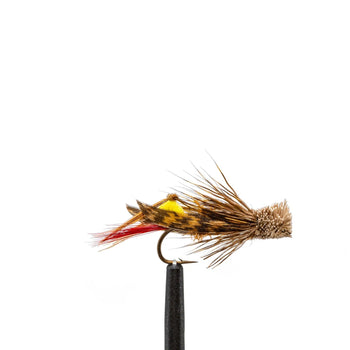 |
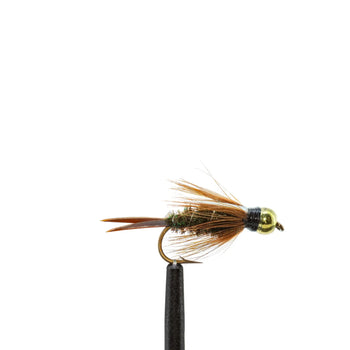 |
| Dave's Hopper | Beadhead Prince Nymph |
Dave's Hopper (sizes 8–12): The classic American hopper pattern, designed by Dave Whitlock and proven over fifty years on every major trout watershed in the country. Spun deer-hair head, palmered hackle body, and yellow segmented underbody match the silhouette and color of a natural grasshopper landing on the water. Carries enough buoyancy to support a beadhead dropper without sinking, and the deer-hair construction sheds water through repeated casts. Fish it tight to grass-lined banks, along undercut shelves, and across any soft seam where naturals would end up drifting after a wind-blown blow-in.
Beadhead Prince Nymph (sizes 12–16): The most universal beadhead nymph in fly fishing. Peacock herl body, biot wings, brown hackle collar, and gold beadhead create an impressionistic profile that suggests dozens of mayfly and caddis nymph species without matching any single one exactly. Fish key on it from spring through fall, in every water type, on every trout watershed in the country. The beadhead drops it into the column at moderate rate — perfect for the eighteen-inch dropper distance under a hopper, hitting the prime mayfly nymph feeding zone six to twelve inches below the surface.
Technical Mayfly Rig
The mayfly rig is for slower water where fish are visibly selective on mayfly activity — spring creeks, soft seams, tailwaters with consistent flow, and the soft inside edges of meadow runs. Hopper-droppers can be too clunky for selective fish; this rig fishes a refined mayfly dry on top with a generalist mayfly nymph below. Use it when you can see fish rising consistently but they're refusing splashy presentations.
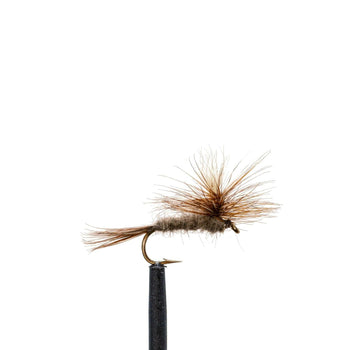 |
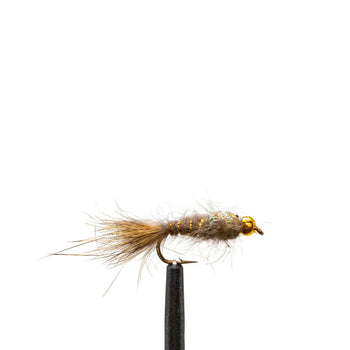 |
| Parachute Adams | Beadhead Hare's Ear Flashback |
Parachute Adams (sizes 14–20): The most useful single mayfly dry pattern ever tied. Gray-brown body, grizzly-and-brown hackle, and white parachute post combine into a profile that matches dozens of mayfly species across every trout watershed — including PMDs, BWOs, Sulphurs, Mahogany Duns, and most of the smaller mayflies anglers can't readily identify on the water. The parachute post sits high enough to track from a low angle, while the body rides flush in the film like a natural dun. Fish it in any water where mayflies are emerging and the fish are showing visible interest in the surface.
Beadhead Hare's Ear Flashback (sizes 12–16): The mayfly nymph workhorse. Hare's mask dubbed body imitates the segmented, hairy profile of ascending mayfly nymphs, and the flashback wing case adds an attractor flash that triggers strikes in dirty water and during heavy hatches when nymphs are actively swimming toward the surface. The gold beadhead drops it into the column at a moderate rate. Run it 18 to 24 inches below the Parachute Adams to fish the column where mayfly nymphs ascend before emergence — the zone where most pre-hatch feeding happens.
Caddis-Water Rig
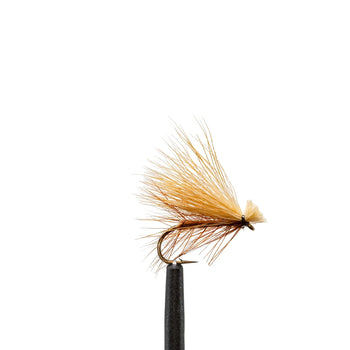
This rig is for riffles, broken water, and any current where caddis are part of the active hatch picture. Caddis activity peaks in the afternoon and evening across most June water, and this pairing fishes the adult caddis on the surface while delivering a fast-sinking attractor nymph through the column. It excels in the kind of broken pocket water where mayfly rigs struggle to track and where fish are eating opportunistically rather than selectively.
 |
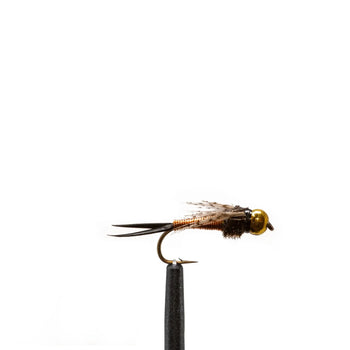 |
| Elk Hair Caddis | Copper John |
Elk Hair Caddis (sizes 14–18): The most durable adult caddis pattern in fly fishing. Palmered hackle and an elk-hair wing keep it floating high through repeated casts in fast water, and the natural deer-hair color matches the dominant tan and olive caddis species hatching across June water. The high-floating profile makes it the right indicator for a beadhead dropper in broken water where less buoyant dries would get pulled under. Carry tan, olive, and black to match dominant local species, and run it across riffles, pocket water, and any broken seam where caddis are active.
Copper John (sizes 14–18): The flashy, fast-sinking dropper for broken water. Copper-wrapped body, biot tail, and tungsten bead drive this fly through the surface tension and into the column faster than any standard beadhead, which makes it the right dropper when current is moving and a slower-sinking nymph would skate above the productive zone. The copper flash triggers reactive strikes in murky water and during heavy hatches when fish are eating opportunistically. Fish it 18 inches below the Elk Hair Caddis in fast riffles, drop the tippet to 12 inches in shallow pocket water.
Heavy Water Rig
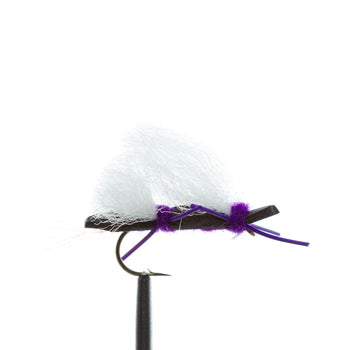
The heavy water rig is for fast pocket water, deep runs, high water periods, and any current where you need maximum dry buoyancy and maximum dropper depth. This is the rig for early-June water that's still moving from late runoff, for deep canyon water, and for any situation where the standard rigs would have the dropper riding too shallow or the dry pulling under. It's also the rig that handles the biggest dropper weight without compromising the surface presentation.
 |
 |
| Chubby Chernobyl – Knockout | Walt's Worm Jig |
Chubby Chernobyl – Knockout (sizes 8–12): The maximum-buoyancy foam attractor for heavy water rigs. Black and purple foam body, rubber legs, and oversize wing post create a fly that supports the heaviest droppers without sinking and triggers opportunistic strikes from fish that have moved into broken pocket water to feed actively. The dark color silhouettes strongly against bright sky from below and remains visible to the angler in all light conditions. Fish it across pocket water, deep runs, and any heavy current where you need both visibility and dropper-support buoyancy.
Tungsten Bead Walt's Worm Jig (sizes 12–16): The deep-water dropper for fast and broken current. The tungsten bead drives this fly into the column faster and deeper than any other nymph in a standard dropper position, which makes it the right pattern when you need the dropper hitting the bottom-third of the water column in heavy flow. The simple dubbed body imitates cranefly larvae, caddis pupae, and a range of generic aquatic worms — fish eat it across every region without selectivity. Run it 24 to 36 inches below the Knockout in deep runs, drop to 18 inches in moderate pocket water.
SHOP THE SUMMER FLY COLLECTION »
Taking It to the Water
The dry-dropper rig isn't a secret technique. It's the practical answer to what most June trout are actually doing — feeding in multiple columns simultaneously, opportunistically, on a mix of insects in different stages. A single fly answers part of the question. A dry-dropper answers more of it.
Pick the rig that matches the water in front of you. Tie it carefully. Mend it deliberately. Adjust the dropper depth until you find where the fish are eating, then leave it there. And remember that the dry isn't just a fishing fly — it's also doing the work of a strike indicator for everything happening underneath. Some of the best fish of June will eat the dropper while the angler is watching the dry, and they'll only be detected by paying attention to what the dry is doing.
Four pairings cover most of what you'll face this month. Carry them, pick the right one for the water, and trust the math.
Related Articles
- Evening Fly Fishing for Trout: The Window Most Anglers Miss
- Yellow Sally: The Most Misunderstood Stonefly in Your Fly Box | Fly of the Month — June 2026
- Late Spring to Early Summer Fly Fishing: A Regional Hatch Guide for Every Major Watershed
- The Two-Fly Rig: Building a Cast for the April Hatch
- 25 Flies Every Beginner Fly Fisher Needs in Their Box


