

Pike & Musky on the Fly: Chasing Freshwater Predators

There's a moment every pike and musky angler knows — a shadow appears behind the fly thirty feet out, tracks it the whole way to the rod tip, and either eats or vanishes without ever giving you a clean shot at it. Nothing else in freshwater fly fishing does that. It's not a subtle take you have to watch for; it's a predator deciding, in real time, whether you're worth the effort.
This is a different game than anything else in the warmwater box. The same mouse pattern that pulls a bass off a bank at dusk is exactly what gets thrown at pike and musky in the right water — we covered that crossover in Fly of the Month: Topwater for Warmwater. This is the rest of that story: the flies, the leader, the figure-eight, and the setup that actually holds up to teeth.
Why Pike and Musky Fish Differently
Bass and panfish generally commit or they don't — you get a strike or you don't get one. Pike and musky follow. A fish can track a fly the entire retrieve, close within inches, and turn away at the last second for no reason you'll ever figure out. That's normal, not a failed cast. The follow itself is information: the fish is there, it's interested, and the next cast to the same water is often the one that connects.
The strike, when it comes, is usually a reaction to a change in speed or direction rather than the fly itself — a pause, a sudden acceleration, or the figure-eight at the rod tip. Fish the retrieve steady and boring, and you'll get followed all day. Fish it like something that's trying to escape, and follows turn into eats.
Learn to read the two by sight before the fish is at the rod tip. A follow shows as a steady shadow tracking behind the fly, holding distance. A strike shows as a flash of white mouth or a sudden boil on the surface — and once you see that flash, the hookset described below needs to happen immediately, not after a beat to process what just occurred.
The Setup: Rigging for Teeth
A standard bass or trout leader doesn't survive contact with a pike or musky — the fish bites through fluorocarbon or mono tippet before you ever feel the take. This isn't optional gear the way it might be for an occasional bass-water pike; it's the difference between landing the fish and losing your fly, your leader, and sometimes the fish itself with a hook still in it.
Build the leader short and heavy: a stout butt section testing well above anything you'd use for bass, stepped down to a bite guard — wire or heavy single-strand mono rated for the teeth you're targeting — tied directly to the fly. Skip the long, gradually tapered leaders that make for delicate presentations elsewhere; turnover on a big, wind-resistant fly matters more than finesse here, and the fish isn't leader-shy the way a pressured trout is.
Rod-wise, this is an 8-weight-and-up game. Anything lighter struggles to turn over the size of fly these fish actually eat, and doesn't have the backbone to move a big fish away from cover before it wraps you around something.
Strip-Strike, Not Rod-Lift
Trout fishing teaches you to set the hook by lifting the rod, and that instinct will cost you fish here. Pike and musky have hard, bony mouths, and a rod-lift often just pulls the fly free before the hook ever finds purchase.
The fix is a strip-strike: keep the rod tip low and pointed at the fly, and drive the hook home with a sharp pull of the line in your stripping hand — not the rod. Only lift the rod once you actually feel solid weight. It fights every habit trout fishing builds, and even experienced anglers catch themselves lifting out of muscle memory. Treat it as the one thing worth consciously thinking about on every take until it's automatic.
The Figure-Eight: Finishing Every Cast
More pike and musky get hooked at the rod tip than anywhere else in the retrieve, which is exactly why the figure-eight exists. When the fly reaches the boat or bank and a fish is still following, don't lift it out of the water — plunge the rod tip in and trace a wide figure-eight or oval pattern, keeping the fly moving in a continuous path with no pause. A following fish reads that continued motion as the last chance to eat before the meal disappears, and the strike often comes right at your feet, closer than feels possible.

The most common mistake is lifting the rod too early because the fish doesn't look interested — patience through the entire figure-eight, every single cast, is what turns follows into fish. Assume every retrieve ends in a figure-eight, whether you've seen a fish or not, since you often won't see the one that's actually there.
📌 Pro Tip: Never lift the fly straight out of the water at the end of a cast, even on retrieves where you never saw a follow. Pike and musky often track a fly in current or stained water without ever breaking the surface enough to spot, and the figure-eight is what gives an unseen follower its last, best chance to commit.
Flies That Get Bit
Big and disruptive beats natural and subtle in this game — these fish are looking for a meal worth the energy of chasing, not a perfect imitation. That said, this isn't a one-retrieve fishery: an attractor pattern stripped fast on top and a weighted sculpin crawled along bottom are catching the same species in completely different ways, and carrying both is what covers a full day on the water.
Several of these patterns — the Pike-style streamers, the Dolly Llama, the Zonker, and the Shad — run through a range of colors beyond what's pictured here, and it's worth letting the water make that call rather than picking a favorite. Dark, natural tones read as the cleanest silhouette in clear water, while bright colors like chartreuse, orange, or red show up better and pull fish from further away once the water turns stained or off-color.
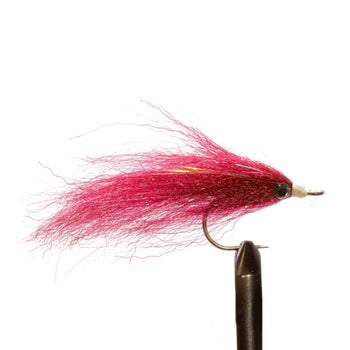
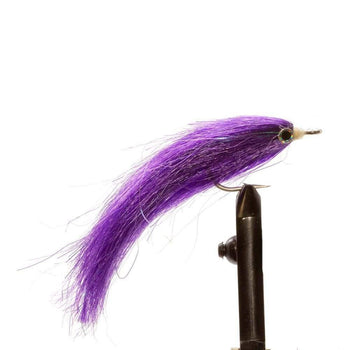
Wine Pike (#4/0): A deep, dark profile that reads as a big, slow-moving meal — the kind of fly that draws a follow from a fish that's not actively hunting. Strip it in long, erratic pulls with real pauses between them; the direction change on the pause is usually what triggers the eat.
Prince Pike (#4/0): Brighter and flashier than the Wine Pike, and the one to switch to when the dark pattern is getting follows but no commitments. More flash reads as more distress, which is sometimes exactly what closes the deal.
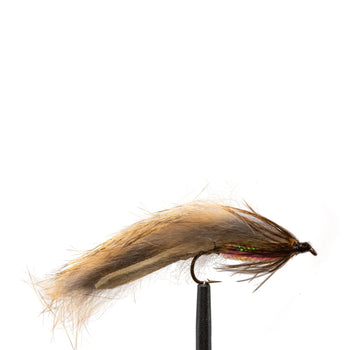
Zonker – Natural (#2–#4 for this fishery): A rabbit-strip streamer that pulses and breathes even on a dead pause, which makes it one of the most natural-looking large flies you can fish for these species. Size up from the trout-stream sizing — the larger end of the run is what belongs on an 8-weight leader.
Bluegill (#4/0): Pike and musky eat a lot of panfish where the two overlap, and this pattern matches that forage directly rather than relying on flash or attraction. Worth tying on specifically in water you know holds bluegill or other panfish — matching what's actually there beats a generic attractor when fish have a strong search image locked in.
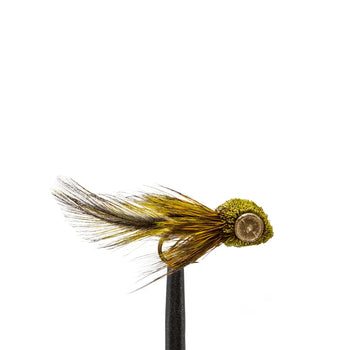
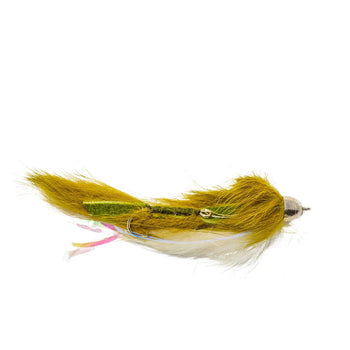
Weighted Sculpin – Olive (#6–#10): The one fly in this lineup built to fish deep rather than in the upper water column — cast it and let it sink fully before starting a slow, bottom-hugging strip with long pauses. Sculpins are a genuine forage source over rock and gravel bottom, and a fish that's ignoring everything moving through mid-water will often still eat one crawled right past its nose.
Dolly Llama – Olive/White (#2–#4): An articulated streamer — two sections joined at a hinge — which gives it a swimming, undulating action a single-piece fly can't replicate. That extra motion is often what turns a follow into a strike on a fish that's already seen everything else in the box today. Fish it with the same long-strip-and-pause cadence as the Wine and Prince Pike, just expect a wider, more exaggerated wiggle on every pull.
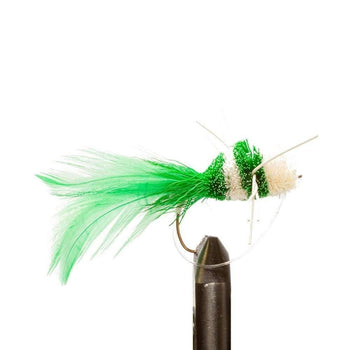
Green/White Bass Bug (#6): A topwater option for the days pike and musky are actively feeding on or near the surface — the same commotion that draws a bass draws these predators too, just fished on the heavier leader this fishery requires.
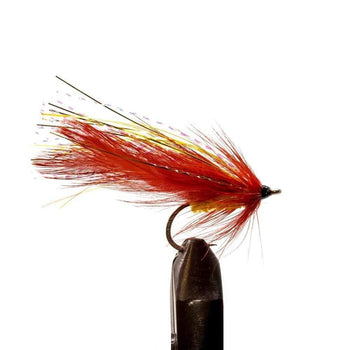
Red Whistler (#1/0–#4): A big, bushy bucktail with bead-chain eyes that give it a diving, jigging action on every pause — cast it, strip, and let it sink on the drop, since that's where most of the strikes happen. Hot red shows up and pulls fish from a distance in exactly the stained or off-color water where a natural pattern gets overlooked.
Beyond the searching patterns and specialty presentations above, a handful of baitfish imitations round out the box — direct matches for the forage fish pike and musky actually key on, each built around a different color and situation rather than one generic "baitfish" look.
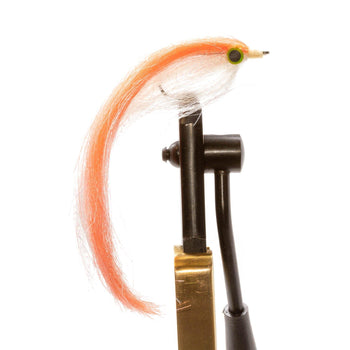
Bozo (#4/0): A hot orange bucktail built to grab attention and trigger a reaction strike rather than fool a picky fish. Strip it with sharp, erratic jerks rather than a steady retrieve — the goal is provoking a reaction in stained or tannic water, not presenting something believable.
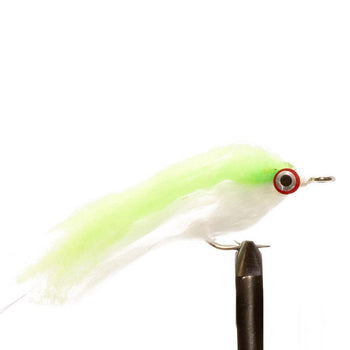
Chartreuse Shad (#4/0): A genuine shad-profile baitfish streamer in the color built for visibility — chartreuse-over-white stays findable in stained or deep water long after a natural silver shad pattern has disappeared. Shad are real forage wherever pike and musky share water with them, and this is the one to reach for when the bite's tied to that specific baitfish.
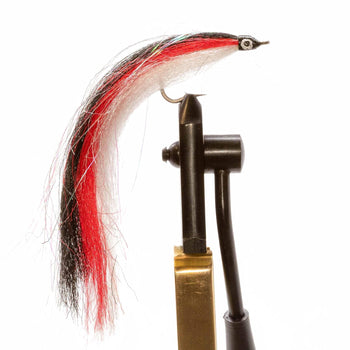
Creek Chub (#4/0): A substantial, dark-backed baitfish pattern built to imitate one of the biggest forage fish in the system. Fish it big and slow through deep holes rather than stripped fast — a chub is a mouthful, and the biggest fish around will move a long way for one rather than chase it down.
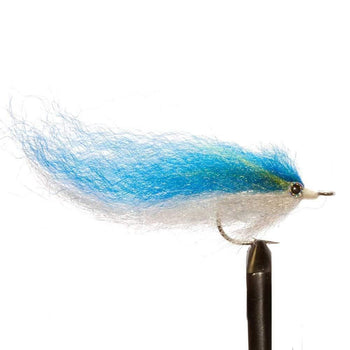
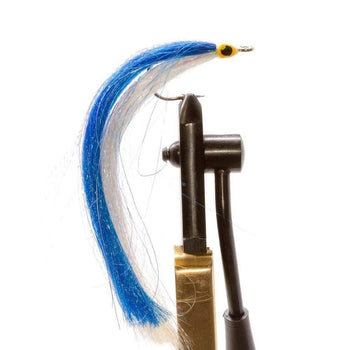
Blue Shiner (#4/0): Blue is a color most anglers never throw in freshwater, which is exactly the point — an open-water shiner imitation built for fast strips over lakes, reservoirs, and big rivers where baitfish roam rather than hold tight to cover. Worth tying on specifically once everything natural-colored has already been through the water.
For anyone who'd rather skip picking colors, the JHFLYCO Loaded Foam Fly Box – Large Streamer Assortment carries a pre-loaded set of proven streamer patterns sized and built for exactly this kind of fishing.
If you fished the topwater guide, you've already got two more patterns that belong here: the Moorish Mouse and Rat-Mouse work exactly the same way here as they do on bass at dusk — same fly, same presentation, different predator. Size up to the #2 for the extra profile these fish key on.
Gear Up: The Predator Kit
The Silvertip Predator Fly Rod anchors this whole setup — a fast-action blank with the backbone to turn over the big, wind-resistant flies this fishery demands, and enough left in reserve to move a big fish away from cover once it's hooked, the same qualities the rigging section above depends on rather than something to work around. It comes in both 9'0" 8WT and 9'0" 10WT; the 8WT covers pike and most freshwater predator work, while the 10WT is worth the step up if musky specifically is the target — bigger fish, longer fights, more sustained pressure to turn.

Paired with the Silvertip Predator Large Arbor Reel — a sealed carbon-and-stainless drag that holds up to a fish mid-run rather than fouling with grit or water, and a large arbor that picks up slack fast enough to stay tight when one of these fish turns and comes straight at the boat, a real situation in this fishery, not a spec sheet nicety.
Both come pre-matched in the Freshwater Predator Rod Combo Kit — the 8WT rod and reel above, pre-spooled with backing and an 8-weight floating line, packed in its own travel tube. It's the fastest way into this fishery without piecing together a rod, reel, and line separately, and the leader system covered above is the only thing left to add before it's fishing. Worth noting: the combo ships in 8WT only — anyone set on the 10WT for musky will want to build that setup piece by piece.
📌 Pro Tip: Handle these fish with the same respect you rig for. Use long forceps or pliers to remove the hook rather than your fingers, and consider a jaw spreader on musky especially — their teeth angle backward, which makes a hand near the mouth genuinely risky even on a fish that looks calm.
Where to Find Them
Pike and musky tend to hold adjacent to the same structure that holds bass and panfish — just staged a little further off it, in position to ambush anything that strays too far from cover. Working the outside edge of the water you'd fish for bass, rather than the thick of the cover itself, is usually where these species actually are.
Weed edges. The line where matted vegetation gives way to open water is a classic ambush lie — cast parallel to the edge rather than straight into the weeds, and work the fly along that seam rather than through the cover itself.
Drop-offs. Anywhere a shallow flat meets a sudden change in depth, especially near timber or rock, gives a predator both an ambush point and quick access to deeper water to retreat into. These spots reward a fly that can cover the whole water column — which is exactly where the Weighted Sculpin earns its place.
Current seams. In moving water, the slower water alongside a faster current is where these fish sit and let the current bring food to them, the same logic that puts a trout behind a rock. Cast across and slightly upstream of the seam and let the fly swing into it.
Low light. Overcast skies, early morning, and last light all tend to pull these fish shallower and make them more willing to chase — the same conditions that make topwater flies worth tying on.
Taking It to the Water
There's no dressing this up as easy fishing. Expect a hundred casts for every follow, and follows for every eat — and when the take finally comes, it's unlike anything else in freshwater fly fishing. Rig for the teeth, strip-strike instead of lifting, and treat a follow as information instead of a failure.
This fishery rewards patience more than anything else in the shop, and that's exactly why the anglers who stick with it get hooked as hard as the fish do.


