

Packing for a Trip: What Makes the Cut

Every fly angler knows the feeling. You're standing in the driveway at 4 a.m. with a duffel, a rod tube, and the creeping suspicion that you've forgotten something. Six hours and one flight later, you find out what it was — usually the one thing you can't buy within a hundred miles of where you're standing.
Packing for a destination fishing trip is its own skill, and it's a different skill than packing for a day on your home water. At home, the truck is your gear closet. On a trip, everything you'll have for the next week is what you decided to carry — and it has to survive a baggage handler, fit an airline's rules, and cover conditions you've only read about.
This is the packing guide we build from. The principle is simple: carry the things that solve problems, leave the things that solve hypotheticals.
Already sorted on where you're going and when? Good — this post picks up after that. If you're still in the planning stage, start with our guide to how to prepare for a fly fishing trip. If your gear needs a once-over before it goes in the bag, run through the essential gear checklist first. And if your trip involves a long walk rather than a long flight, our backcountry essentials guide is built for that.
Start With the Rod That Travels
Every rod worth taking on a trip has one thing in common: it breaks down into four pieces. A four-piece rod fits a tube that fits in a duffel, an overhead bin, or a checked bag — which is why every rod we build is a four-piece. The question isn't whether your rod travels. It's which one earns the slot.
Pick for the water, not the trip. A 9'0" 5WT is the correct answer for most destination trout travel — it handles dries, nymph rigs, and light streamers, and it won't leave you undergunned if the wind comes up. Going somewhere with tight brush and small water? A shorter, lighter rod is the better tool. Chasing bigger fish in bigger water? Step up a weight. And if you're taking exactly one rod on a trip you've been planning for a year, take the one you cast best.


Yellowstone Signature (9'0" 5WT): The most advanced rod we build, and the one to take when the trip matters. If you've been planning this one for a year, saved for it, and only get a handful of days on the water, the Signature is the rod that won't be the limiting factor. Precision, recovery, and the kind of feel that makes a long day of casting effortless.
Yellowstone II (9'0", 4–7WT): Our flagship and the workhorse of destination travel. Fast-action IM8 graphite with the backbone to punch a hopper-dropper into wind and the finesse to fish a small dry when it lays down. Available in 4 through 7 weight, so you can match the rod to the trip — 5WT for general trout, 6 or 7 for bigger water and bigger fish.
Silvertip 9'0" (5–6WT): The smart travel choice — a medium-action rod that casts smoothly, handles a wide range of water, and costs little enough that you won't panic when the tube comes down the baggage carousel. Plenty of anglers keep a Silvertip as their dedicated travel rod for exactly that reason.
Silvertip 7'0" 4WT: The small-water rod. When the destination is spring creeks, tight brush, or a mountain stream full of eager fish, a shorter 4WT is genuinely the better tool — it casts where a 9-footer can't, it's a joy on smaller trout, and it packs down shorter.
📌 Pro Tip: Carry your rod on if you possibly can. A four-piece in a hard tube fits most overhead bins, but airline policies vary wildly and gate agents don't always agree with each other — so have a backup plan and get to the gate early. If you must check it, a hard-sided rod case with a reel pouch keeps rod and reel protected and together, which is worth the space it costs.
The Pack Is the Decision
Your pack is the single most consequential choice on this list, because it defines everything else. A small pack forces discipline. A large pack invites overpacking. And on a trip, your pack does double duty — it's your carry-on getting there and your fishing pack once you arrive.
Waterproof matters more when you travel. At home, a soaked pack is an annoyance. On day three of a trip, with no way to dry anything and no replacement within a hundred miles, it's a real problem. Roll-top waterproof construction isn't a luxury on a destination trip — it's insurance.
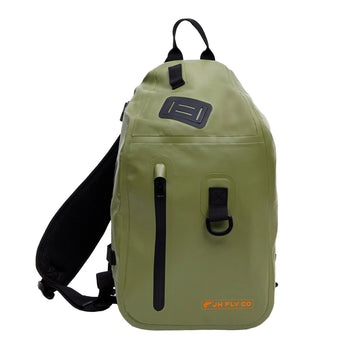
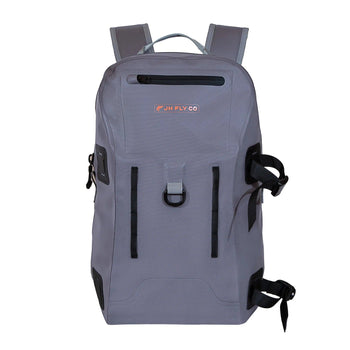

20L Waterproof Sling Pack: The best single answer for most trips. Big enough to carry a full day's gear plus a layer and lunch, small enough that you can't overpack it, and it swings around to your chest for access without coming off your body. Recent upgrades added an internal mesh pocket, a Velcro fly patch for drying flies, and sturdier attachment points for tools and a net.
27L Waterproof Backpack: The multi-day option, and the better choice if your pack is pulling double duty as a carry-on. The extra capacity swallows rain gear, layers, and a lunch alongside your fishing kit, and the two-strap carry is more comfortable through an airport than a sling. Roll-top construction keeps everything dry from the boat ramp to the afternoon thunderstorm.
13L Adjustable Sling Pack: The minimalist option, and a great second pack for half-days and short walks from the lodge. When the plan is to move fast with a box, a spool, and a few tools, 13 liters is plenty — and the lighter load is a genuine pleasure on a hot afternoon.
Tools: Bring the Kit, Not the Pile
Here's the failure mode every traveling angler knows. You assemble your tools over years — nippers from one place, forceps from another, a zinger you bought in an airport, floatant from the bottom of a vest pocket. It works fine at home. Then you pack for a trip, grab what you can find, and discover on day one that the nippers stayed in the truck.
The fix is to stop assembling and start carrying a kit. One package, everything in it, nothing to forget. It's the single highest-leverage change you can make to how you pack.
 |
 |
 |
 |
| Pro Streamside Toolkit Plus | Essential Streamside Toolkit | Pro Tippet System – Loaded | Slim Magnetic Fly Box |
Pro Streamside Toolkit Plus – Loaded Tippet Edition: Every tool, every tippet, one kit. This is the complete Pro toolkit with the tippet already loaded — which means the entire "did I bring enough 5X?" problem disappears before you leave the house. If you take one thing from this list for a destination trip, take this.
Essential Streamside Toolkit: Everything a working angler actually reaches for, in one box — forceps, nippers, a silicone fly box, a pin-on zinger, a measuring tape, a Caddy-Sak pre-loaded with gel floatant, a tippet T-holder, and a leader straightener. Read that list again and notice how many of those are the exact items people forget. That's the point. At this price it's easy to keep a second one permanently packed in your travel bag so you never think about it again.
Pro Tippet System – Loaded 2X–6X: The tippet problem solved end to end. The Pro Tippet Holder pre-loaded with spools from 2X through 6X, so you're covered from big nymph rigs down to tiny dries without carrying a pocketful of loose spools. On a trip where conditions change daily, this is the range you actually need.
Slim Magnetic Fly Box: Built for exactly the constraint travel imposes — it holds a real selection and takes up almost no room doing it. Twelve magnetic compartments grip flies securely without foam, and the fully waterproof shell means a river crossing or an afternoon downpour is a non-event.
Flies: Build for Where You're Going
The temptation on a trip is to bring everything. Resist it. A traveling angler's fly selection should be built around the water you're actually going to, not every scenario you can imagine — and it should live in as few boxes as possible, because every box is another thing to lose, soak, or leave on a tailgate.
Do the homework before you pack: call the shop nearest your destination, read the local reports, and ask what's hatching that week. Then build one box around that answer, plus a small handful of confidence patterns you'd fish anywhere. A large double-sided waterproof fly box holds a genuinely complete travel selection: dries on one side, nymphs and streamers on the other. If your boxes ride in a checked bag, an aluminum fly box handles the abuse better — plastic cracks, aluminum doesn't. And if you'd rather have the selection made for you, a loaded fly box arrives curated and organized.
The one thing worth bringing extra of: tippet. It's light, it's small, and running out of the size you need in a place where you can't buy more is genuinely trip-altering. Everything else you can improvise.
Don't Forget: The Non-Gear Checklist
Here's the part that sinks more trips than any missing fly box. None of the following is fishing gear, and every one of them has ruined somebody's week. Run this list the night before you leave.

Licenses and paperwork. Buy your destination state's fishing license online before you go — don't count on a shop being open when you arrive. Screenshot it, and print a copy if you're heading somewhere without cell service. Same for guide confirmations, lodge reservations, and any special-water permits.
Polarized sunglasses — and a spare. Sunglasses are the one piece of gear that's both essential and easy to break, sit on, or drop in the river. A backup pair weighs nothing and saves a trip.
Sun and bug protection. Sunscreen, lip balm with SPF, and bug spray. Long days on the water at altitude will punish you for skipping these, and the fly shop at the lodge charges triple.
Rain shell and a warm layer. Mountain weather doesn't care what the forecast said. A packable rain jacket and one insulating layer take up almost no room and mean a cold afternoon doesn't end your day.
Wading boots — cleaned and dried. Many states have invasive-species regulations, and some require boots to be clean and dry before entering new water. Beyond the legal issue, it's simply the right thing to do. Clean them at home, not in a hotel bathtub.
A dry bag for the important stuff. Phone, wallet, keys, and documents. One small dry bag inside your pack means a capsized boat or a slip in the river is an inconvenience rather than a catastrophe.
Cash for tips. If you're fishing with a guide, bring cash. Standard is 15–20% of the day rate, and card readers don't work where you're going.
First aid and blister care. Bandages, moleskin, ibuprofen, and tweezers. New boots plus long days equals blisters, and a hook in the finger is a whole lot easier to handle with real tools than a multi-tool and optimism.
Battery bank and charger. You'll use your phone for photos, maps, and reports, and you'll drain it faster than you expect. A small battery bank covers a full day.
Water and snacks. Obvious until it's four in the afternoon, you haven't eaten since six, and the fishing's finally good.
📌 Pro Tip: Pack one full day of fishing essentials in your carry-on — a reel, a spool of tippet, a fly box, and your license. If your checked bag doesn't show up, you can still fish day one while the airline sorts it out. Anglers who've had a bag go missing never travel any other way again.
What to Leave Home
A packing list is only half the job. The other half is the discipline to leave things behind, and it's the part most anglers skip.
The second and third rod. Unless the trip genuinely spans two different fisheries, one rod plus a spare tip section beats two full setups you'll never both use.
Fly boxes for water you're not fishing. Your winter midge box has no business on a summer trip. Pull it out and put it back on the shelf.
The "just in case" gear. The extra reel, the spare line, the third rain jacket. If you can't name the specific situation where you'd use it, it stays home.
Anything you haven't used in a year. The vest-pocket archaeology every angler discovers — dried-out floatant, a rusted hook file, split shot from 2019. A trip is a good excuse to clean house.
Taking It to the Water
The best-packed trip isn't the one with the most gear. It's the one where everything you brought gets used and nothing you needed got left behind. That balance comes from packing deliberately — a rod that suits the water, a pack that enforces discipline, tools that travel as a kit, a fly selection built for where you're actually going, and the unglamorous list of licenses, layers, and sunscreen that keeps a trip from going sideways.
Do it right and you'll notice something on the water: you stop thinking about your gear entirely. Everything's where it should be, nothing's missing, and all that's left is the fishing. Which was the point of the trip in the first place.


