

Fly of the Month: Stoneflies – The Biggest Bug in Your Box

The biggest, meatiest insect in most Western rivers — and the one trout build their year around.
Walk up to any freestone river in May, flip over a softball-sized rock in the riffle, and you'll likely see something that looks more like a small lobster than an insect. That's a stonefly nymph. Two tails, six prominent legs, a segmented body that can reach two inches on a salmonfly — these are the heaviest mouthful most trout get all year.
And here's the part that catches a lot of anglers off-guard: the famous salmonfly hatch — the one that draws anglers from across the country to the Madison, the Big Hole, the Yellowstone — only lasts a few weeks. The rest of the year, stoneflies live underwater as nymphs, crawling along the substrate, getting dislodged in current, and ending up in trout stomachs. Which means stoneflies aren't a hatch you fish for two weeks in June. They're a year-round food source you can fish from January to December — you just have to know whether to throw a nymph or a dry.
Here's how to fish them right now, and how to be ready when the dry fly window opens.
The Stonefly Lifecycle and Why It Matters to Anglers
The stonefly has a long lifecycle compared to most aquatic insects, often spanning one to three years, with the vast majority of that time spent underwater as a nymph. Unlike mayflies and caddis, stoneflies don't emerge in the surface film — they crawl out of the water onto rocks, logs, and streamside vegetation before splitting their nymphal skin to become winged adults. This single behavior shapes nearly everything about how trout eat them and how anglers fish them.
Understanding this lifecycle helps anglers know when to fish nymphs deep, when to fish the banks tight, and when to switch to dries. Stoneflies go through three major stages: egg, nymph, and adult. Trout feed heavily during two of these phases — nymph and adult — with the nymph stage producing the bulk of the eating opportunities throughout the year, and the adult stage delivering the most explosive dry fly fishing of the season when conditions align.

- Egg Stage: After mating on land, female stoneflies fly back to the water and deposit eggs on the surface, where they sink and adhere to the streambed. Eggs hatch within a few weeks to a few months depending on water temperature.
- Nymph Stage (Year 1): Newly hatched nymphs are tiny and cling to the undersides of rocks in fast, oxygenated water. Trout feed on them opportunistically as they get dislodged in current.
- Nymph Stage (Years 2–3): As nymphs grow, they molt repeatedly and become a major food source. Salmonfly and golden stone nymphs reach 1–2 inches long. This is the stage trout key on most of the year — drifting through the column or crawling along the substrate.
- Pre-Hatch Migration: As they near maturity, mature nymphs migrate from mid-stream toward the banks, concentrating in shallower water along the edges. This migration creates a feeding window where bank-tight nymphing outproduces mid-river drifts.
- Crawl-Out Emergence: Unlike mayflies and caddis, stoneflies do not hatch in the water. They crawl up onto rocks, logs, and vegetation along the bank, where they split their nymphal shuck and emerge as winged adults. Empty shucks left on streamside rocks are a clear signal the hatch has begun.
- Adult Stage: Adults live one to four weeks, mostly out of the water — clinging to streamside vegetation, mating, and flying in clumsy bursts. Trout don't eat them during this phase unless the wind blows them onto the water.
- Egg-Laying Flight: Females fly back over the water to drop or skitter their eggs onto the surface. This is when adult stonefly dry fly fishing peaks — fluttering, oversized bugs landing on the water trigger the most aggressive surface strikes of the year.
- Spent Adults: After egg-laying, adults die and fall to the water. Trout pick off these spent insects in slower seams and back eddies, especially in the morning following an evening egg-laying flight.
By timing your fly choice to these stages — fishing rubber-leg nymphs deep in mid-stream most of the year, shifting to bank-tight nymphs in the days before the hatch, then switching to high-floating foam dries during the adult egg-laying window — you'll cover stoneflies at every productive moment of their lifecycle.
The Four Stoneflies That Matter Most
Stoneflies aren't one bug. They're a family with hundreds of species, but four species drive almost all the fishing decisions you'll make.
Salmonfly (Pteronarcys)
The big one. Adults are two to three inches long with dark orange-black bodies. Nymphs are dark brown to nearly black, sized #4–#8. The salmonfly hatch is the most anticipated dry fly event of the year on rivers like the Madison, Henry's Fork, Big Hole, and Deschutes — typically late May through June, moving upstream as water warms.
Golden Stone (Hesperoperla and Calineuria)
The understudy that often outperforms the headliner. Adults are golden-yellow, an inch and a half long, sized #6–#10. Goldens overlap with salmonflies but extend further into summer, giving you stonefly dry fly water for weeks after the salmonfly hatch winds down. Nymphs are tan to golden-brown.
Yellow Sally (Isoperla)
The small one, and the most consistent. Adults are bright yellow, three-quarters of an inch, sized #14–#16. Yellow sallies hatch from late spring through summer, often when nothing else is happening, and they're an underrated dry fly opportunity on summer afternoons.
Early Black Stones (Capnia, Taeniopteryx)
The cold-water specialists. Small, dark, sized #14–#18, hatching in late winter and early spring when most anglers assume nothing is happening. These are the patterns that produce on a sunny February afternoon when nothing else will.
Searching Nymphs and Rubber Legs
Most of your stonefly fishing — by a wide margin — happens with a weighted nymph below the surface. Rubber legs patterns are the workhorses of this game. They aren't trying to imitate any specific stonefly perfectly — they're a generalist's nymph that suggests "big crawly thing" to a trout, and they fish well year-round in any river that holds stoneflies.
These are the rubber legs and searching patterns to anchor your stonefly box.
Heavy anchors — get deep fast
 |
 |
 |
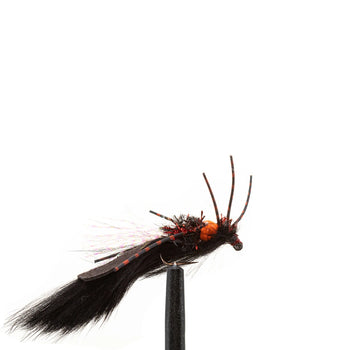 |
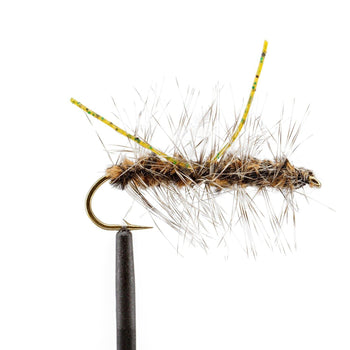
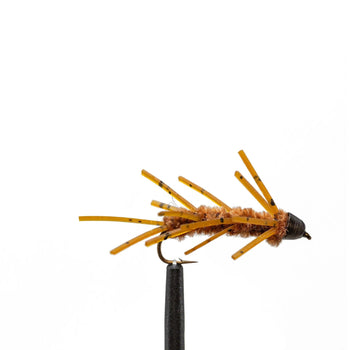
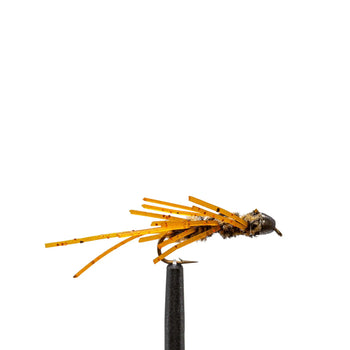
| Conehead Yuk Bug – Rootbeer | Conehead Rubber Legs – Coffee | Conehead Rubber Legs – Cream Soda | Orange Bead Zirdle Bug – Black |
Conehead Yuk Bug – Rootbeer (#6–#10): The dual-purpose pattern that fishes equally well as a salmonfly nymph or golden stone nymph. The rootbeer color sits perfectly between dark and tan, and the conehead gets it down fast. The flash collar adds attraction in off-color water — particularly effective during runoff or in stained tailwater. Strong as the anchor on a two-fly nymph rig.
Conehead Rubber Legs – Coffee (#6–#10): The dark version when you want a clean salmonfly profile. The coffee body is deep brown-black, matching mature salmonfly nymphs perfectly, and the conehead drops it to the rocks immediately. Fish this through deeper runs and along undercut banks where big nymphs concentrate before the hatch.
Conehead Rubber Legs – Cream Soda (#6–#10): The golden stone counterpart. The cream/tan body matches golden stone nymphs in clearer water and lighter substrate. Use this when you've turned over rocks and seen tan-colored naturals, or when you're fishing rivers known for heavy golden stone populations like the Yellowstone and Henry's Fork.
Orange Bead Zirdle Bug — Black (#4–#8): A heavy hybrid — Zonker rabbit strip body with rubber legs and a hot-spot orange bead for added attention. Fishes deep, undulates with current, and triggers aggressive strikes in fast or off-color water. The orange bead makes this a standout in stained spring runoff conditions when standard patterns get lost in the murk.
Mid-weight workhorses — the everyday standards
 |
 |
 |
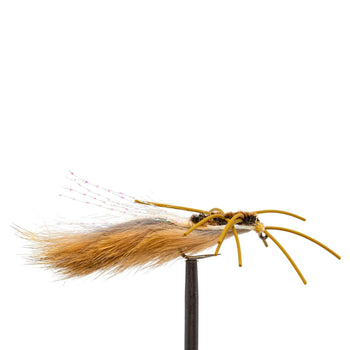 |
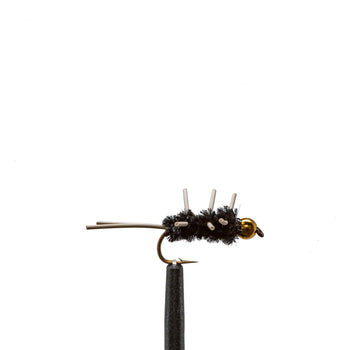
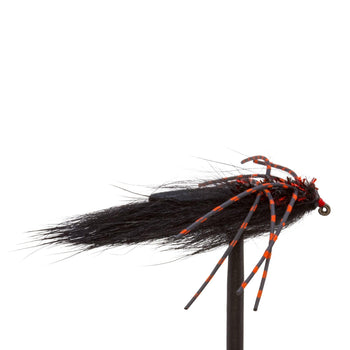
| Rubber Legs - Rootbeer | Beadhead Girdle Bug | Zirdle Bug — Black | Zirdle Bug — Natural |
Rubber Legs – Rootbeer (#6–#12): The modern guide favorite without the conehead. Lighter sink rate gives you better drift control in mid-depth water — perfect for standard nymph rigs in seams, tailouts, and pocket water that doesn't require an aggressive plunge. The rootbeer color works for both salmonfly and golden stone water.
Beadhead Girdle Bug (#6–#10): The classic black chenille searching nymph with a bead for moderate weight. Fishes a foot or two off the bottom in standard riffle-run-pool sequences, exactly where most stonefly nymphs drift. A box without a Beadhead Girdle Bug is missing a foundational pattern.
Zirdle Bug — Black (#4–#8): The dark version of Kelly Galloup's hybrid pattern. Fishes both as a dead-drift salmonfly nymph and as a swung/stripped streamer. The rabbit strip undulates in current, suggesting a swimming or migrating nymph rather than a stationary one. Particularly effective during the pre-hatch window when nymphs are actively moving toward the banks.
Zirdle Bug — Natural (#6–#10): The tan/golden version for golden stone water. Same hybrid design, lighter color profile, slightly smaller average size. Strong choice for tailwaters and clearer freestone rivers where fish see more pressure and golden stone nymphs are the dominant food.
Lighter droppers and small stones
 |
 |
 |
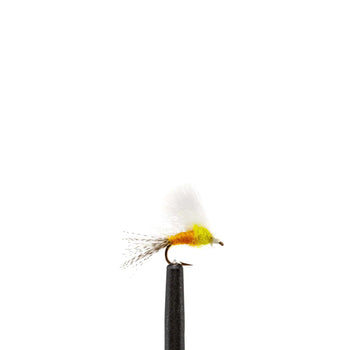 |
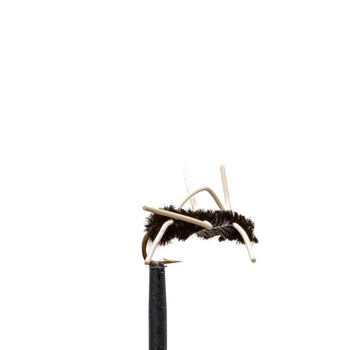
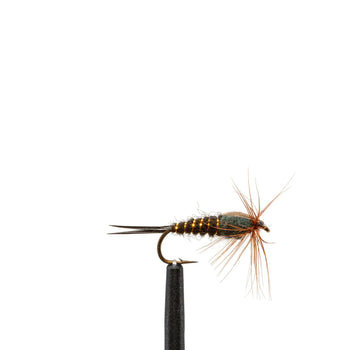
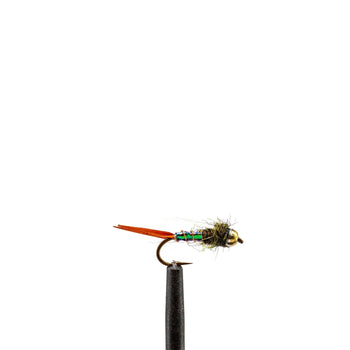
| Girdle Bug | Black Stonefly Nymph | Beadhead Flash Prince Nymph | Yellow Sally CDC Emerger |
Girdle Bug (#8–#12): The unweighted version of the classic. Use it as a dropper below a foam dry fly during the dry-dropper window, or as the second fly on a tandem nymph rig where the heavier conehead pattern is doing the anchor work. The lack of a bead lets it drift more naturally and match dislodged nymphs that aren't actively crawling.
Black Stonefly Nymph (#10–#16): The pattern for early black stones in winter and pre-runoff conditions, and for downsized salmonfly imitations when fish get pressured. The smaller sizes (#14–#16) are essential for January–March cold-water stonefly fishing on tailwaters and freestones at lower elevations.
Beadhead Flash Prince Nymph (#10–#14): The bridge pattern that imitates small stoneflies, caddis pupae, and mayfly nymphs all at once. The peacock body and flash add subtle attraction without overpowering. A go-to dropper below any of the heavier rubber legs patterns above — you'll catch fish on this fly that refuse the bigger lead.
Yellow Sally CDC Emerger (#14–#16): Matches the small Yellow Sally hatch when it comes off in summer afternoons. The CDC wing pulses naturally and rides in or just below the surface film, exactly where Yellow Sally adults emerge. Underrated dry-dropper trailer fly during July and August on Western tailwaters.
📌 Pro Tip: A rubber legs as your point fly with a smaller mayfly nymph or caddis pupa as a dropper is one of the most productive two-fly rigs in Western fly fishing. The rubber legs gets the rig down and acts as the attractor; the smaller bug is what most fish actually eat.
Specific Stonefly Nymphs for the Salmonfly Window
When stoneflies start migrating toward the banks in late May to hatch, trout shift from picking up the occasional drifting nymph to actively keying on them. This is when more realistic patterns start to outperform the generalist rubber legs.
Heavy anchors — get deep fast in faster water
 |
 |
 |
 |
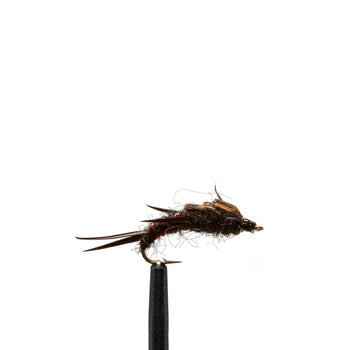
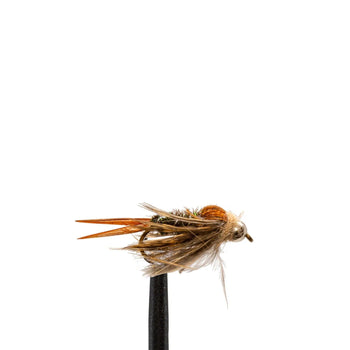
| Kaufmann's Stonefly — Black | Kaufmann's Stonefly — Brown | 20 Incher | Beadhead Flashback Stonefly — Black |
Kaufmann's Stonefly — Black (#6–#10): The classic realistic salmonfly nymph. Randall Kaufmann's pattern has been catching trout on the Madison, Henry's Fork, and Big Hole for decades. The segmented body, biot tails, and weighted underbody give it the exact silhouette of a mature salmonfly nymph migrating toward the banks. Fish dead drift through deeper runs.
Kaufmann's Stonefly — Brown (#6–#10): The golden stone version. Same construction, lighter brown body color matching mature golden stone nymphs in pre-hatch water. Pair it with the Black version on a two-fly rig if you're not sure which species is dominant — the trout will tell you which they prefer.
20 Incher (#6–#10): A peacock-and-chenille generalist that fishes as both a salmonfly and golden stone nymph. The peacock body adds natural iridescence that triggers strikes, and the heavy weight gets it to the rocks fast. This is the pattern to reach for when you don't know exactly what's working — it covers more stonefly water than almost any other realistic pattern.
Beadhead Flashback Stonefly — Black (#6–#10): Adds a flashback wingcase to the standard black stonefly silhouette, which catches light and triggers strikes in slightly off-color water. The bead and weight get it down fast. Particularly effective during the height of the pre-hatch window when fish are actively keying on migrating nymphs.
Mid-weight realistic profiles — for clearer water and selective fish
 |
 |
 |
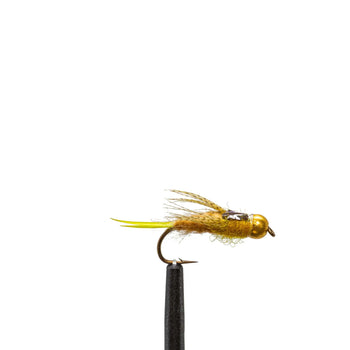 |
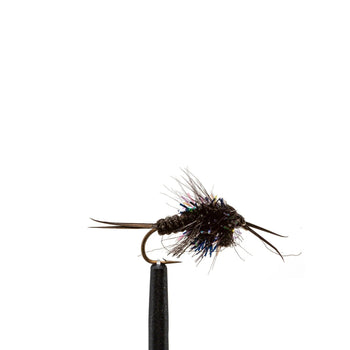
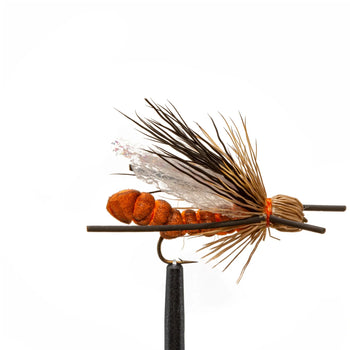
| Mark's Stonefly — Black | Mark's Stonefly — Brown | Southfork Stone | Beadhead Golden Stone |
Mark's Stonefly — Black (#6–#12): A more modern realistic pattern with a soft hackle collar that adds movement the Kaufmann's lacks. The soft hackle pulses with the current, suggesting a swimming or dislodged nymph rather than a stationary one. Particularly effective when fish are getting selective during the height of the pre-hatch window. The wider size range lets you match smaller mid-season stones too.
Mark's Stonefly — Brown (#6–#12): The golden stone version. The brown body matches mature golden stones, and the soft hackle gives it the same lifelike movement as the black version. Strong choice on Henry's Fork, Madison Valley, and other rivers where golden stones outnumber salmonflies.
Southfork Stone (#6–#10): A specialized pattern designed for the South Fork of the Snake and similar Western rivers — a realistic stonefly profile with subtle flash and a weighted body. Fishes well on a dead drift through transitional water where current speeds up before dropping into a deeper run.
Beadhead Golden Stone (#6–#10): A heavier realistic golden stone nymph with a tungsten or brass bead. Drops to the rocks fast and matches mature golden stone nymphs in pre-hatch water. The bead's added weight makes this a strong anchor or first fly on a tandem nymph rig in faster water and deeper runs. Pair it with the Mark's Stonefly Brown for a pure golden stone presentation.
📌 Pro Tip: The Zirdle Bug fishes best on a slight strip-pause retrieve, not a dead drift. The rabbit strip wants to undulate. Cast across, mend once, and let the fly swing through the seam with light pulses on the line. Strikes are usually violent.
Adult Dries for the Big Show
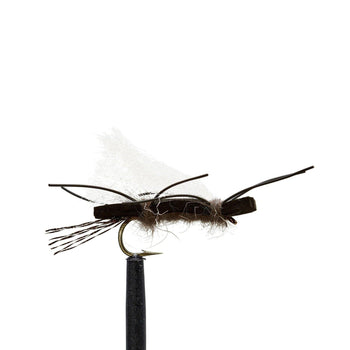
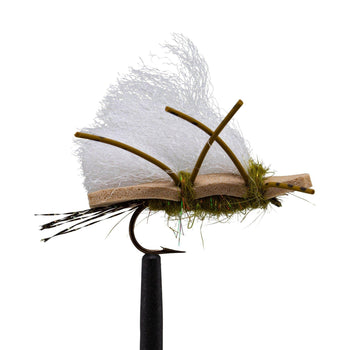
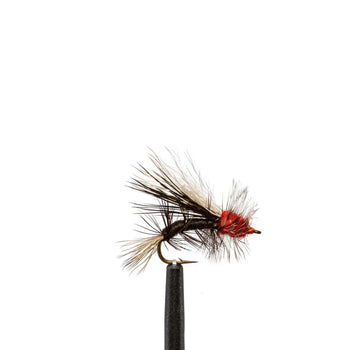
When you start seeing adult salmonflies in the willows and trout boiling at the surface, switch to dries. The Chubby Chernobyl in its various colorways is the workhorse — dark for salmonflies, tan for goldens. The realistic profiles work when fish get picky in slower water.
 |
 |
 |
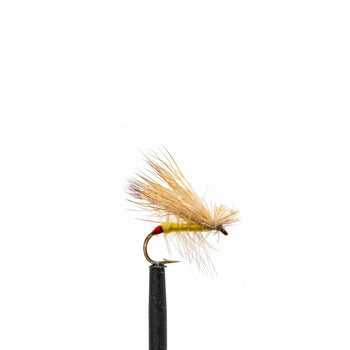 |
| Chubby Chernobyl — Black | Chubby Chernobyl — Tan/Olive | Black Stimulator | Yellow Sally |
Chubby Chernobyl — Black (#6–#8): The high-floating salmonfly attractor. Foam body, white poly wing, dark rubber legs — built to stay on the surface in fast water and visible to both fish and angler. The Black Vader version is your salmonfly hatch dry, particularly effective during egg-laying flights when females skitter across the water dropping eggs.
Chubby Chernobyl — Tan/Olive (#8–#10): The golden stone match. The Duck Camo colorway lands somewhere between tan and olive, perfectly matching the body color of golden stones drifting on the surface. Goldens overlap with salmonflies but extend further into summer, making this the pattern that keeps producing after the salmonfly hatch winds down.
Black Stimulator (#8–#14): The traditional salmonfly attractor that predates the Chubby. The hair wing, palmered hackle, and segmented body give it a more realistic adult stonefly silhouette than the foam Chubby — particularly effective when fish refuse the foam attractor in clearer water or slower seams. The smaller sizes (#12–#14) also work as Early Black Stone imitations in winter and pre-runoff.
Yellow Sally (#14–#16): The summer afternoon insurance policy. Yellow Sally hatches run from late spring through summer, often when nothing else is happening. Fish this in the smallest sizes you carry and look for trout sipping in slower water through afternoons in July and August. Often the only dry fly that works during midsummer slow periods.
📌 Pro Tip: When the hatch is on but fish aren't eating your dry, drop a stonefly nymph 18–24 inches below it. The dropper often outproduces the dry by 3 to 1 — but the strikes you do get on top are worth every drift.
When to Fish Stones Year-Round
Stonefly nymphs aren't a May-only fly. Here's the rough seasonal map:
Winter (December–February): Small dark stones (#14–#18) in slower water and deeper runs. Trout are slow but stones are still moving along the bottom.
Early Spring (March–April): Mid-size dark stones and rubber legs in the #8–#12 range. Pre-runoff, this is some of the most productive nymphing of the year.
Late Spring (May–June): Peak nymph season as bugs migrate toward the banks to hatch. Big rubber legs, Kaufmann's, and 20 Inchers in the #4–#10 range. The salmonfly dry fly window opens late in this period.
Summer (July–August): Goldens still hatching, yellow sallies heavy through afternoons. Hopper-stonefly droppers become the dominant rig.
Fall (September–November): Goldens taper off, but rubber legs nymphs remain a top searching pattern in any river that holds stones.
The point is simple: a well-stocked stonefly box covers more of your fishing year than almost any other category in your fly box.
Taking It to the Water
The temptation in May is to go straight to the big foam dries because the salmonfly hatch feels close. Resist that for now. Most days through May, the nymph game is going to outproduce the dry game by a wide margin — sometimes 10 to 1. Get your weighted rubber legs, Girdle Bugs, and Kaufmann's down to the rocks, run a smaller dropper behind it, and fish the seams and pockets where stoneflies live.
When you start seeing adult salmonflies in the willows and trout boiling at the surface, then it's time to switch. The dry fly window is short, intense, and often the best fishing of the year. Be ready for it.
If you want a single box that covers stoneflies through every life stage and every season, our brand-new JHFLYCO Stonefly Life Stages Assortment brings it all together — six proven nymph patterns covering both salmonfly and golden stone profiles in multiple sizes and weights, plus two adult dries to match the egg-laying flights when trout finally look up. From early-season black stones through summer goldens, this is the box to anchor your stonefly fishing year-round.
The 8 patterns inside: Beadhead Micro Golden Stone, Southfork Stone, Kaufmann's Stonefly Nymph – Black, Mark's Stonefly – Brown, Golden Stone (adult), Rootbeer Yuk Bug Conehead, Black Stimulator (adult), and Beadhead Flashback Stonefly Nymph – Black.


