

Sight Fishing Low, Clear Summer Water: Fooling Fish That Can See You Coming

By mid-July, a lot of rivers have dropped into their summer shape: low, clear, and slow. The runoff is a memory, the water is warm, and what's left is a river you can see straight to the bottom of. It's beautiful — and it's the hardest, most humbling fishing of the year.
Here's why. In high, off-colored spring water, trout can't see much, so they're forgiving. They hold in obvious lies, eat with confidence, and never get a good look at your leader. Low, clear summer water flips all of that. The fish can see everything — your leader, your line, your shadow, and you. They've been fished over all season, they're on edge, and they will refuse a fly for reasons you'll never fully diagnose.
The good news: this is also the most rewarding fishing there is. When the water goes clear, the game changes from covering water to hunting individual fish — spotting a specific trout, planning an approach, and making one good cast count. It's fly fishing at its most visual and most deliberate. Get it right and you'll remember the fish. Here's how to tilt the odds in your favor.
First, Learn to See
Sight fishing starts before you make a cast — it starts with spotting the fish. In clear water, the angler who sees the most fish catches the most fish, and seeing them is a skill you build, not a gift you're born with.
Start with your eyes' equipment. Polarized sunglasses are non-negotiable. They cut the surface glare that hides everything beneath it, turning an opaque sheen into a window. Copper or amber lenses are ideal for the freestone and tailwater light most of us fish in summer. Without polarized glasses, you're fishing half-blind.
Stop looking for whole fish. You'll rarely see a trout outlined like a photograph. Instead, train your eyes to catch the signs of a fish: a shadow on the streambed that doesn't belong, a flash of white as a mouth opens, a tail slowly waving, a shape that shifts when everything else stays still. Movement and shadow give fish away long before their outline does. Look through the water, not at its surface, and scan slowly.
Use the light and slow down. Position yourself so the sun is at your back or side, never in your eyes, and the water's glare drops away. Move slowly along the bank, pausing often to really look — most anglers walk right past fish because they're moving too fast to see them. In skinny summer water, trout hold in specific places: the soft cushion in front of a boulder, the shaded seam under an overhanging bank, the foam line where food funnels, the tail of a pool where they can watch upstream. Learn those lies and you'll know where to look.
The Approach: Get Low, Go Slow
Once you've spotted a fish, the fish becomes the whole world — and the way you approach it decides everything. In clear, calm water, trout are exquisitely tuned to disturbance. A heavy footstep, a wading push of water, a shadow falling across the lie, a fly line waving overhead — any one of these sends the fish bolting or, worse, locks its jaws shut so it sits there and refuses everything you throw.
Stalk from downstream. Approach from downstream and behind whenever you can, because a trout faces into the current and its blind spot is directly behind it. Move slowly and deliberately. Get low — crouch, kneel, and if the fish is close and spooky, cast from your knees. Staying off the skyline matters more than anglers realize; a silhouette against bright sky reads as a predator to a fish that's spent its life being hunted by ospreys and herons.
Wade like you're sneaking up on the fish — because you are. Every push of water and grind of gravel telegraphs your presence through a medium that carries vibration far better than air. If you can make the cast from the bank without wading at all, do it. The best sight-fishers often catch their fish before they ever step into the water.

The Presentation Problem — and the Fix
Here's the hard truth of clear water: your normal presentation, the one that works fine in broken pocket water, will spook these fish. Everything that's forgiven in fast, off-colored water is punished in slow, clear water. The leader lands too close and casts a shadow. The fly line splashes down in the fish's window. The tiniest drag — invisible to you — screams "fake" to a trout that has all the time in the world to inspect the drift.
The fix comes down to three things: a longer, finer connection between you and the fly, a softer delivery, and making the first cast count.
Go long and go fine. This is where a longer leader earns its keep. In clear water, lengthen your leader to 12 feet, and often 15, so the fly line lands far from the fish and the delicate end of the tippet is all the trout sees near the fly. Drop your tippet diameter — 5X for most dry fly work, 6X or even 7X when fish are truly technical. And fish fluorocarbon tippet: it sinks slightly, refracts light much less than nylon, and is far harder for a wary fish to detect underwater. A long fluorocarbon leader and fine fluoro tippet are the single biggest presentation upgrade you can make on clear water.
Deliver it softly. Slow down your casting stroke and aim to land the fly, leader, and line as gently as possible. Use reach casts and slack-line casts to drop the fly upstream of the fish with a cushion of slack, so it drifts drag-free into the feeding lane before the current can grab your line. Keep false casting away from the fish — never wave the line back and forth over its head. Ideally the only thing that enters the fish's window is the fly and a few inches of near-invisible tippet.
Make the first cast count. On clear water, your best shot is almost always the first one. The first accurate, drag-free drift over an unpressured fish is when it's most likely to eat. Every cast after that raises the odds the fish notices something's wrong. So don't rush a sloppy first cast — take an extra moment to check your angle, your distance, and your drift, then put it exactly where it needs to be. One perfect cast beats ten hurried ones.
The Stealth Gear
You don't need much for clear-water sight fishing, but the few things you carry should all serve stealth and presentation. This is a game of long, fine, invisible connections and clean, high-floating flies — here's the core kit.


Fluoroflex Fluorocarbon Tippet: The stealth tippet. Fluorocarbon refracts light far less than nylon and sinks slightly, so it disappears near your fly in the exact conditions where a trout is looking hardest. Carry 4X through 6X (add 7X for spring creeks) and step down until the refusals stop. On clear water, tippet diameter is often the difference between a look and an eat.
Fluoroflex Fluorocarbon Tapered Leader: Start with a quality 9-foot fluorocarbon leader and extend it with tippet to 12–15 feet for the spookiest fish. The long, fine taper keeps your fly line well away from the trout and turns over a delicate presentation without piling up. A dedicated clear-water leader is the foundation everything else builds on.
Gel Flote with Caddy-Sak: A high-floating, natural-looking dry fly is essential when fish are inspecting every drift. Gel floatant lets you work flotation precisely into the hackle and body before your first cast, keeping small dries riding clean and drag-free in the film — right where a technical trout expects a real insect to sit. The Caddy-Sak keeps it clipped to your pack and hands-free, so you can treat the fly before you approach, not after you've spooked the pool.
For a deeper dive on building the right connection to your fly, read our full guide to choosing the right leader and tippet.
The Right Flies for Clear Water
Clear-water fly selection is the mirror image of the big-foam summer game. Where fast pocket water rewards a big, visible attractor the fish reacts to, clear flat water rewards the opposite: small, natural, low-visibility patterns that don't set off alarm bells. A trout that will crush a size-8 Chubby Chernobyl in a riffle will bolt from it on a glassy tailout. Downsize, go natural, and match the naturals as closely as you can. These four are proven clear-water performers.
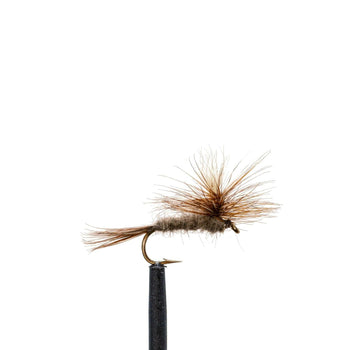

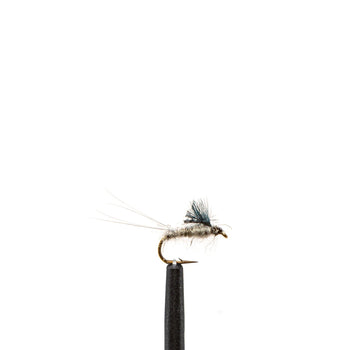
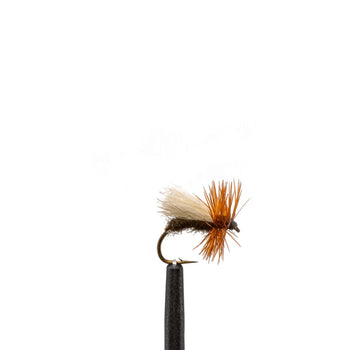
Parachute Adams (#16–20): The flush-floating natural. Its low profile sits in the film rather than on top of it, giving a realistic silhouette to fish that are studying every drift, while the parachute post keeps it visible to you. A buggy, non-specific mayfly shape that fools trout on smooth water where a high-riding attractor gets refused.
Mayfly – Black (#14–18): A sleek, minimalist dark mayfly for low light and selective feeding. The slim, dark body reads as a real insect against a bright sky and gives spooky fish nothing to object to. When the naturals are small and the fish are picky, a subtle dark silhouette often out-produces anything flashier.
RS2 (#18–22): When fish are sipping just under the surface and refusing your dry, they're usually eating emergers — and the RS2 is the answer. Fish it in the film as a trailer behind a visible dry, or greased to ride just under the surface. Sparse, subtle, and deadly on technical clear-water trout keyed on the emergence.
Peewee Alpine Ant (#12–16): The subtle terrestrial for skinny summer water. Where a foam hopper is too much fly, a small, realistic ant drifted tight to the bank is often the pattern that finally gets eaten. Trout see ants as a safe, familiar, high-protein meal — and this low-riding little fly slips past their defenses when louder terrestrials won't.
📌 Pro Tip: When a fish refuses your first few drifts, resist the urge to keep casting — that's how you burn a fish. Rest it. Watch what it's actually eating. Change your fly or drop a tippet size before you cast again. On clear water, the angler who slows down and observes almost always out-fishes the one who keeps chucking.
A Word on Warm, Low Water
Low, clear summer water is often warm water, and that deserves a moment of care. When water temperatures climb, trout are already stressed, and a hard fight in warm water can be fatal even if the fish swims away. Fish the cooler hours — early morning and evening — carry a thermometer, and when the water gets too warm, have the discipline to reel up and go do something else. A landed fish isn't worth a dead one. When you do hook up, land the fish quickly, keep it wet, and release it with care. For the full picture on protecting the fish you catch, read Catch and Release Done Right.
Taking It to the Water
Sight fishing clear summer water is the closest thing fly fishing has to hunting. You spot the animal, you plan the stalk, you get one good shot. It demands more of you than any other kind of trout fishing — better eyes, a quieter approach, a more perfect presentation — and it gives more back. The trout you fool on a glassy flat with a 15-foot leader and a size-20 dry is the one you'll be telling stories about all winter.
So slow down. See the fish before it sees you. Get low, go fine, and make the first cast count. The hardest fishing of the year is also the most rewarding — and now you know how to meet it.


