

Reading Water 101: Where Trout Actually Hold

You have the rod, you can put a fly out thirty feet, and now you're standing on a gravel bar looking at a hundred yards of river that all looks exactly the same. This is the moment a lot of new fly anglers quietly decide they're bad at this.
They're not. They just haven't learned to read water yet.
Reading water is the skill that separates people who catch fish from people who practice casting. It's also the cheapest skill in fly fishing — it costs nothing, you can start learning it from the bank before you ever get in, and it pays off on every river you'll ever stand in. A mediocre cast into the right seam catches more trout than a beautiful cast into dead water. Every time.
Here's how to look at a river and know where to start.
Trout Are Lazy, and That's the Whole Secret
Every trout in the river is solving the same equation: maximum calories for minimum effort, without getting eaten. That's it. That's the entire behavioral model, and once you have it, the river stops looking like water and starts looking like a map.
A trout swimming hard in fast current burns more energy than the food drifting past can replace. A trout sitting in dead water where no food comes through starves slowly. So they position themselves in the narrow band between those two problems — somewhere they can hold with almost no effort, right next to water that's delivering food.
A good lie gives a trout three things at once. Relief from the current, so it isn't burning energy to stay put. Access to a food lane, so it can move a few inches and eat. And cover from above, whether that's depth, broken surface, shade, or an overhanging bank — because ospreys and herons are real and trout know it.
Water that offers all three holds fish. Water that offers one or two holds fish sometimes. Water that offers none is where most beginners spend their day.
If You Learn One Thing, Learn Seams
A seam is the line where fast water meets slow water. You can see them — a visible crease on the surface, often marked by a line of bubbles or a change in color and texture where two current speeds run side by side.
Seams matter because they solve the trout's equation perfectly. The fish sits on the slow side, holding easily. The fast side acts as a conveyor belt, pushing food past its nose. The trout moves a few inches, eats, and drops back. It's the most efficient arrangement in the river, and it's why seams hold more fish per square foot than anything else.
Every piece of structure in a river creates a seam. Boulders, gravel bars, bends, logs, the edge of a fast riffle where it drops into a run — anywhere the current is forced to split or slow, there's a seam and there's probably a trout on it.
If you take nothing else from this guide: find the line where fast water meets slow water, and put your fly on the slow side of it.
The Anatomy of a Run
Most trout water repeats the same four-part sequence over and over: riffle, run, pool, tailout. Learn to recognize the pattern and you can walk up to an unfamiliar river and know what you're looking at.
The riffle is the food factory. Shallow, fast, broken water tumbling over cobble — it looks too skinny and too rough to hold anything. It holds plenty. Riffles are where aquatic insects live, the churn puts oxygen in the water, and the broken surface hides both the trout from predators and you from the trout. Fish the edges where it deepens, and fish the bottom of the riffle hard where it drops into the run below.
The run is the sweet spot. Below the riffle, the water deepens and slows into a walking-pace current with a slightly broken, textured surface. Depth, moderate flow, cover, and a steady food supply arriving from the riffle above — this is the best all-around trout water in the river, and it's where a beginner should spend most of their time.
The pool is deep, slow, and harder than it looks. Everyone wants to fish the pool because it looks fishy, and there are fish in it. But the current is slow enough that trout have all day to inspect your fly, and the flat surface means they see you coming. The best part of a pool is almost always the head, where the run pours in and the current is still defined.
The tailout is the most overlooked water in the river. At the bottom of a pool, the water shallows and speeds up before spilling into the next riffle. Food gets funneled through a narrowing throat, and big fish often move up into a tailout to feed — especially in low light. It's also glassy and shallow, so it's the easiest water in the river to blow. Approach it like you're sneaking up on something, because you are.

Structure: Rocks, Banks, and Wood
A boulder in the current creates more holding water than any other single feature. Most anglers know to fish behind a rock. Fewer know to fish in front of it. As current hits a boulder it piles up and deflects downward, creating a cushion of slow water on the upstream face — and that's often the better lie, because a fish sitting there sees food first.
Behind the rock you get the pocket: a patch of calm water with seams running down both sides. Fish the seams before you fish the middle. And keep going — the two seams eventually converge downstream into a single line of soft water that can hold fish well past the rock itself.
Undercut banks are prime real estate and almost nobody fishes them properly. On the outside of a bend, current carves in under the bank and leaves a shelf of cover with deep, slow water beneath it. It's shade, it's depth, it's an escape route, and food washes right along the edge. The catch is that you usually have to get your fly within inches of the bank to matter, which means accepting you'll lose a few flies. Lose them.
Wood holds fish and eats flies. A logjam or a sunken tree gives trout structure, shade, and current break all at once. Fish the upstream edge and the seams alongside it rather than trying to thread a fly into the middle of the tangle.

📌 Pro Tip: Before you make a single cast, stand back from the water and watch it for two full minutes. You'll spot seams, rises, and current lines that are invisible once you're standing in the river looking down at it. Two minutes of watching regularly saves an hour of casting at nothing.
Foam Is Food
Where you see a line of foam on the surface, you're looking at a current lane. The same forces that collect bubbles collect drifting insects, which means a foam line is a visible marker of exactly where food is being delivered. It's the single most useful visual cue on a river, and it's free — you don't have to interpret anything, you just have to look.
Drift your fly down the foam line. There's a lot more to it than that, and we've written the whole thing up in our guide to fishing the foam line.
Water You Can Skip
Knowing what not to fish saves more time than knowing what to fish. Long, featureless flats with uniform depth and no current variation rarely hold much — there's nothing for a trout to hold behind and nothing concentrating food. The middle of a wide, slow pool under bright midday sun is usually a poor bet for the same reasons.
And the water you just waded through is done. Trout scatter when a person walks through their lie, and they don't come back quickly. This is the argument for fishing water before you stand in it, which brings us to the part most beginners get backwards.
How to Approach It
Fish the closest water first. The instinct is to wade out and cast to the far bank, and that instinct puts you standing on top of the fish you could have caught from dry ground. Work the near seam, then the middle, then the far side. You'll be surprised how often the fish were three feet from where you were about to stand.
Approach from downstream. Trout face into the current, which means they're looking upstream. Coming from below puts you in their blind spot and lets you get much closer than you'd think. Moving downstream toward them does the opposite.
Work upstream in short steps. Cover the water in front of you thoroughly, take a few steps up, repeat. Fishing thirty feet of river carefully beats covering three hundred yards carelessly, especially when you're learning — because when a fish eats, you'll know exactly what kind of water it came from, and that's how the skill compounds.

📌 Pro Tip: Polarized sunglasses aren't a comfort item — they're a reading-water tool. They cut surface glare and let you see depth changes, submerged rocks, drop-offs, and sometimes the fish themselves. It's the single biggest upgrade to how much of the river you can actually see.
The Order of Operations
When you walk up to an unfamiliar piece of river, run it in this order:
Stop and look before you do anything. Find the seams — the lines where fast meets slow. Find the foam. Identify what you're looking at: riffle, run, pool, or tailout. Pick the closest good-looking water to where you're standing, and fish it before you take a step. Then work upstream, near to far, in short deliberate moves.
That's the whole method. It looks like a lot written down and it takes about ten seconds once it's habit.
What to Fish It With
Reading water tells you where. These four cover most of what it tells you to do — a searching dry for seams and banks, a big foam attractor for broken water, a bead nymph for runs, and a streamer for the deep, dark places.
 |
 |
 |
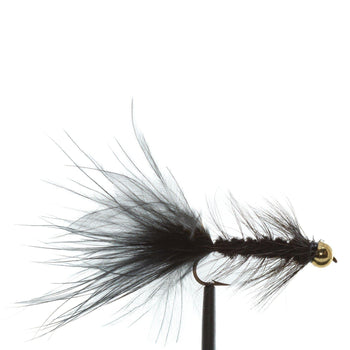 |
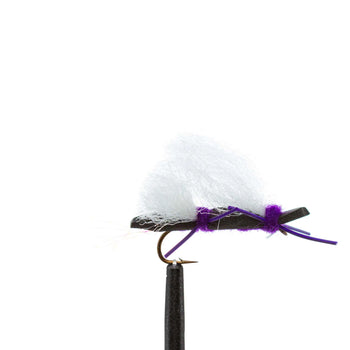
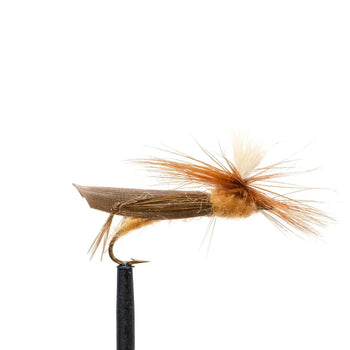
| Chubby Chernobyl | Parachute Hopper | Beadhead Pheasant Tail | Beadhead Woolly Bugger |
The Chubby Chernobyl rides high in riffles and pocket water where a smaller dry disappears, and it'll suspend a dropper underneath. The Parachute Hopper is the searching dry for seams and undercut banks — low-riding enough for fish that have time to look. The Beadhead Pheasant Tail is your default dropper, fished through runs and behind boulders. And the Beadhead Woolly Bugger covers the deep pools and dark undercuts you can't see into.
Getting on the Water
Reading water is not a body of knowledge you memorize — it's a way of looking. The vocabulary helps, but the actual skill is trained by standing in rivers, making a guess about where a fish should be, and finding out whether you were right.
You'll be wrong a lot at first. Then one day you'll walk up to a river you've never seen, look at a seam sliding past a rock, put a fly on it, and catch a trout on the first cast — and it'll feel like the river finally started speaking a language you understand. That's the whole thing. It's worth the wrong guesses.
If you're still building out your setup, our Fly Fishing Essentials collection covers the line, leaders, tippet, and tools that make up a complete rig. And if you're just getting started, our beginner's guide library covers everything from rigging and knots to casting and choosing your first flies.
Now go find a seam.
Related Articles
- Fishing the Foam Line: Why Foam Is Food and How to Read It
- How to Rig Your Fly Rod: A Complete Beginner's Guide
- Sight Fishing Low, Clear Summer Water
- Cast Like a Pro: Techniques for Precision Fly Casting
- 25 Essential Flies Every Beginner Needs
- Starting Your Fly Fishing Journey: A Beginner's Guide
- Browse All Beginner's Guides →


