

Fly Fishing for Beginners: The Complete Starter Guide

Fly fishing has a reputation for being complicated, and the gear is most of the reason why. Walk into a shop and you'll hear about grain weights, taper profiles, and tippet diameters measured in thousandths of an inch — none of which you need to understand to catch your first trout.
Here's what's actually true: fly fishing needs five things to work. A rod, a reel, a line, something clear connecting the line to the fly, and the fly. Everything else is refinement. This guide covers those five, the handful of accessories that genuinely earn their space, and what to do once you've got them.
The Five Things You Actually Need
The rod is the engine, and one size covers most of the country. A 9'0" 5-weight is the closest thing fly fishing has to a default — long enough to control line at distance, light enough for small water, and matched to the trout most people are fishing for. If your water is small and brushy, an 8'0" or 8'6" in a 4-weight handles it better. If you're throwing big streamers or fishing wind, step up to a 6-weight. But if you don't know yet, buy the 5-weight — we make the full case for it in Why a 5WT Is the Most Versatile Rod in Fly Fishing. Not sure what your water calls for? Our rod selector asks where you fish and points you to the right weight, and How to Buy a Fly Rod goes deeper on action, length, and materials.
The reel matters less than you've been told — up to a point. On trout water, the reel mostly stores line. Its drag becomes important when a fish runs far enough to pull line off the spool, which happens less often than beginners expect. What does matter is that the reel is balanced to the rod. A 5-weight rod wants a 5/6 reel, and a mismatched setup feels wrong in the hand every cast.
For a first reel, the Silvertip Discovery 5/6 removes a step you'd otherwise have to do yourself. It ships pre-spooled with backing, fly line, and leader already on it — so it arrives balanced, correctly loaded, and ready to fish. There's a 3/4 version for lighter rods. If you'd rather spool your own or you're pairing to a heavier rod, browse the full reel lineup.
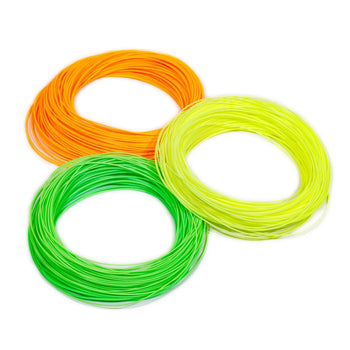
The fly line is the part beginners underrate most. In spin fishing, the lure's weight carries the cast. In fly fishing, the line does — the fly weighs almost nothing. That makes the line the single most important piece of gear for how casting feels, and a cheap line on a good rod feels worse than a good line on a cheap rod. Start with a weight-forward floating line matched to your rod weight. That covers dry flies, nymphs, and most of what you'll do in your first few seasons. Our Fly Line 101 guide covers tapers, types, and how to tell when a line is worn out. Browse fly line and backing when you're ready.
Leader and tippet are the invisible link. A leader is a tapered length of clear monofilament — thick where it attaches to the fly line, fine where it attaches to the fly — and the taper is what makes a fly turn over and land softly instead of piling up. A 9-foot 5X tapered leader is the standard starting point for trout. Tippet is a spool of level line in the same diameter as your leader's fine end; you add a foot or two to extend the leader's life as you cut flies off and tie new ones on. If the X-sizing system is confusing — and it is — Choosing the Right Leader & Tippet explains it properly. Both live in our leader and tippet collection.
 |
 |
 |
 |
| Silvertip Fly Rod | Silvertip Discovery 5/6 | Weight Forward Fly Line | Tapered Leader — 3 Pack |
That's four of the five. the Silvertip 9'0" is our entry rod and a medium action that's forgiving to learn on, the Discovery 5/6 arrives pre-spooled and correctly balanced to it, a weight-forward floating line is the all-purpose choice, and tapered leaders come three to a pack because you will lose them.
Flies are where it gets fun, and where beginners overspend. You don't need two hundred patterns. You need a small selection that covers the three things trout eat — insects on the surface, insects underwater, and baitfish — in a couple of sizes each. We've written the whole thing up in 25 Essential Flies, and our loaded fly boxes package a working selection in a box that's ready to fish.
📌 Pro Tip: Rod weight, line weight, and reel size should all match. A 5-weight rod takes a 5-weight line and a 5/6 reel. Mismatching them is the most common setup mistake beginners make, and it makes casting harder for reasons that are almost impossible to diagnose on the water.
The Shortcut: Buy It as a Kit
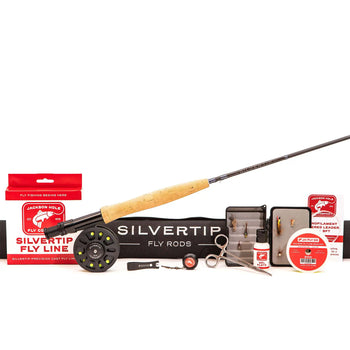
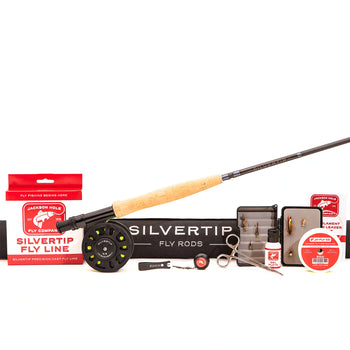
Assembling five components correctly is a real barrier, and it's the one we built the combo kits to remove. Every kit pairs a rod with a matched reel, and the reel arrives pre-spooled with backing, fly line, and leader already on it. That means the balance is right, the line weight is correct, and the reel is rigged before it reaches you — three of the five decisions made, and the fiddliest one already done.
 |
 |
 |
 |
| Granite Creek — 7'0" 4WT | Crystal Creek — 9'0" 5WT | Crystal Creek Plus — 9'0" 5WT | Jackson Lake — 9'0" 6WT |
Granite Creek is the short 4-weight — the right call for kids, small brushy creeks, and anyone who wants the least intimidating way in. Crystal Creek is the classic first outfit: a 9'0" 5-weight, the do-everything trout setup. Crystal Creek Plus is the same rod and reel with the extras that turn it into a complete kit. And Jackson Lake steps up to a 6-weight for stillwater, wind, and bigger flies.
Kits span from a compact starter outfit for kids and small streams — see Kids & Fly Fishing if you're buying for a young angler — up through complete setups that include a rod tube, flies, and tools. If you're not sure which fits your water, our combo kit finder walks you through it in a few questions. You can also browse beginner kits or the complete kits directly.
Buying separately isn't wrong — it's how you build a setup that's exactly what you want, and it's what most anglers end up doing for their second rod. But for a first outfit, the kit removes the part of this that stops people before they start.
What Else Goes in the Pack
A handful of accessories genuinely change the day, and most of the rest doesn't. Nippers to trim knots, forceps to back a hook out of a fish, a floatant to keep dry flies riding high, and something to carry it all. That's the working set. You can buy those pieces individually, but a streamside toolkit gathers them into one thing you clip on and forget about — which matters more than it sounds, because the tool you left in the truck is the tool you don't have.
Polarized sunglasses aren't a comfort item. They cut surface glare and let you see depth changes, submerged rocks, and sometimes the fish themselves. For reading water they're closer to essential equipment than to an accessory, and they're also the only thing standing between your eye and a badly timed cast.
A net helps the fish more than it helps you. A rubber-mesh landing net lets you control a fish quickly, keep it in the water, and get the hook out without handling it much — which is most of what catch and release actually comes down to.
Waders extend your season into cold water, but they're not a first purchase. Most people fish their first summer in shorts and old sneakers and do fine. Buy them when the water gets cold enough that you stop wanting to get in it.
 |
 |
 |
 |
| Essential Streamside Toolkit | Gel Flote | Large Waterproof Fly Box | 20L Waterproof Sling Pack |
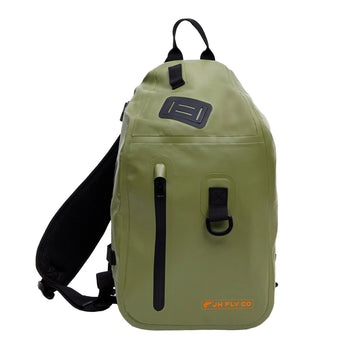
The Essential Streamside Toolkit gathers nippers, forceps, and a zinger into one clip-on unit. Gel Flote keeps dry flies riding high after a fish has soaked them. A large waterproof fly box holds far more than you'll start with, which is the point — you'll grow into it, and How to Organize Your Fly Box covers how to fill it sensibly. And a sling pack keeps everything on your back and out of the water while still swinging around to the front when you need it.
Putting It Together
A new rod arrives in pieces, and the line doesn't come attached to anything. Assembling the rod, seating the reel, and connecting backing to line to leader to tippet is a twenty-minute job the first time and a five-minute job forever after — but nobody is born knowing the order or the knots.
We walk through all of it, with diagrams, in How to Rig Your Fly Rod. If you bought a combo kit, most of that work is already done for you — you'll be starting at the tippet.
There are three knots worth learning, and honestly only one you'll tie regularly: the improved clinch, which attaches the fly to the tippet. Our essential knots guide covers that one and the rest.
Learning to Cast
The core idea of fly casting is that you're throwing the line, not the fly. The rod loads with energy on the back cast and releases it forward, and the line carries the nearly weightless fly along with it. Almost every beginner problem — piled line, cracking sounds, flies landing in a heap — traces back to rushing that rhythm rather than to a lack of strength.
Smoothness beats power, and pausing at the top of the back cast to let the line straighten behind you fixes more problems than any other single adjustment. You can practice all of this on grass with no fly attached, which is the fastest way to improve and costs nothing.
For the actual mechanics — grip, stance, stroke, and the common faults — read Cast Like a Pro. Once the cast is landing where you want it, mending is the next skill that changes your results.
📌 Pro Tip: Most fish are caught inside thirty feet. Beginners spend enormous effort learning to cast far and almost none learning to cast accurately at short range, which is backwards. A tight, accurate twenty-five foot cast will out-fish a sloppy sixty-footer every day of the week.
Where to Fish
Knowing where to cast is a bigger skill than knowing how, and it's the one nobody teaches you. Trout aren't distributed evenly through a river. They sit in specific places that give them relief from the current, a steady supply of food drifting past, and cover from above — and those places look like ordinary water until you learn to see them.
The single most useful thing to look for is a seam: the line where fast water meets slow. Trout hold on the slow side and eat from the fast side, which makes seams the highest-percentage water in any river. You can spot them from the bank before you ever get in.
We cover the whole subject — seams, riffles, runs, pools, tailouts, and where fish sit around a rock — in Reading Water 101.
For your first few outings, though, pick easy water. A small stream or a pond gives you room to make mistakes without consequence, and small fish eat more willingly than big ones. Save the famous river for when your cast is reliable.
Fishing Like Someone Who'll Be Welcome Back
Fly fishing runs on unwritten rules, and violating them is the fastest way to have a bad day on crowded water. Don't drop in above someone who's working upstream. Give other anglers room — more than feels necessary. If you're passing someone, go well around and behind them, out of the water if you can.
Handle fish as little as possible. Wet your hands before touching one, keep it in the water, get the hook out quickly, and let it swim off under its own power rather than dropping it. Barbless hooks — or barbs pinched down with forceps — make all of that faster and easier. Our guide to catch and release done right covers the rest.
And check your local regulations before you go. Licenses, seasons, and gear restrictions vary by state and sometimes by individual stretch of river. Most states sell licenses online in about five minutes.
Where to Go From Here
Fly fishing rewards patience more than talent, and everyone is bad at it for a while. The first season is largely about building enough competence that the mechanics stop occupying your attention — and once they do, the rest of it opens up.
Start with reliable gear, learn to cast at short range, and spend real time looking at water before you fish it. That's most of the game.
If you're ready to build a setup, our combo kit finder matches you to a complete, balanced outfit in three questions, and the Fly Fishing Essentials collection covers everything else. And our beginner's guide library has the rest of the fundamentals in one place.
Related Articles
- How to Rig Your Fly Rod: A Complete Beginner's Guide
- Reading Water 101: Where Trout Actually Hold
- How to Buy a Fly Rod: A Simple Guide for Anglers of All Levels
- Fly Line 101: Types, Tapers & When It's Time for a Replacement
- Choosing the Right Leader & Tippet for Fly Fishing Success
- 25 Essential Flies: A Beginner's Guide to Building the Perfect Fly Box
- JHFLYCO 101: How to Tie 4 Essential Fly Fishing Knots
- Cast Like a Pro: The Ultimate Guide to Precision, Power, and Presentation
- Catch and Release Done Right: Ensuring a Healthy Future for Our Fish
- Browse All Beginner's Guides →


