

Fly of the Month: Yellow Sally – The Most Misunderstood Stonefly in Your Box

The Hatch You've Been Fishing Wrong
By early June, the rivers are doing something different than they were a month ago. Snowmelt is dropping out of the freestones, tailwaters are running clean and steady, and the bugs that defined spring — caddis, March Browns, the first PMDs — are giving way to a different cast of characters. Among them: one small yellow stonefly that hatches every warm afternoon from late May into August, on nearly every wild trout watershed in the country, and rarely gets the attention it earns.
Most anglers who fish Yellow Sallies are fishing them wrong. They've got the right fly in the box. They put it on the line during what looks like the right window. They make decent drifts in decent water. And they catch a fraction of what's actually possible. Then they shrug and say the hatch is unreliable.
The hatch isn't unreliable. The angler's read on it is.
This is the deep dive on Yellow Sallies — the small yellow stoneflies of the Isoperla, Suwallia, and related genera. We'll cover where the pattern came from, how to actually read the hatch, the three mistakes that cost anglers fish on Sally water, and the eight patterns that earn their place in a Sally fly box. By the end of this post, you'll know more about the fish than you do about the bug — which is the point.
In our regional hatch guide for late spring and early summer, we made the case that Yellow Sallies are the producing hatch most Western anglers ignore while they're busy chasing the Salmonfly. That argument holds up. But it's only half the story — because knowing which hatch to fish doesn't help much if you don't know how.
A Brief History of the Yellow Sally Pattern
The Yellow Sally as a recognized fly fishing target traces back to the late 19th-century British wet fly tradition, where small yellow stoneflies were imitated with soft-hackled wet patterns fished downstream and across. Those early wet flies are the genetic ancestors of the modern emerger patterns — same idea, different materials.
The American version of the Yellow Sally evolved on Western freestone rivers in the mid-20th century. Anglers like Polly Rosborough and later Jack Dennis tied small yellow stonefly imitations specifically for the Isoperla hatches that exploded on the Snake, the Madison, and the Henry's Fork from June through July. The classic hackled dry pattern we still fish today — yellow body, light dun or grizzly hackle, single tail — is essentially unchanged in design from those early tiers.
The Yellow Humpy, which we feature in the lineup below, comes from a parallel lineage. Jack Horner's original Humpy, tied in California in the 1940s, was designed as a buoyant attractor for fast pocket water — not as a specific Sally imitation. But the silhouette and size of the Yellow Humpy turn out to match Yellow Sallies almost perfectly, and Western anglers adopted it as one of the most productive Sally patterns by the 1960s. It's a useful reminder that the best "imitation" doesn't always start as one — it just has to look right to the fish.
Foam transformed Sally patterns in the 1990s and 2000s. The Yellow Foam Stimulator and its descendants gave anglers a Sally pattern that could ride through fast riffles and pocket water without sinking, and crucially, work as the visible anchor in a dry-dropper rig. CDC emergers came along in the same era, addressing the long-ignored truth that fish often eat Yellow Sallies before they fully emerge. The full modern lineup — nymph, emerger, dun, attractor — exists because the hatch demands it. Most fly boxes are missing at least one of those stages.
📌 Pro Tip: When you encounter a Yellow Sally hatch on unfamiliar water, the first pattern out of the box should be the one that matches what you actually see — adults on the water means a dry, swirls below the surface means an emerger, no activity means a nymph. Don't tie on what worked yesterday. Tie on what's working now.
Reading the Yellow Sally Hatch
Yellow Sallies break almost every rule that applies to mayfly hatches, and that's the first thing to understand. If you're used to reading PMD or Sulphur hatches, you'll mis-read Sallies in three different ways before you even tie on a fly.
When they hatch. Mayfly hatches happen in the cooler parts of the day — morning, late afternoon, evening. Yellow Sallies hatch in the warmest hours. Peak activity is typically between 11 AM and 4 PM, with the strongest emergence happening on sunny afternoons when air and water temperatures both spike. Cloudy, cool days can suppress the hatch entirely. Bright sun and warm air are the trigger.
Where they hatch. Mayflies emerge from soft, silty, slower water. Yellow Sallies emerge from fast, oxygenated, rocky water — riffles, pocket water, runs broken by structure. Adults concentrate in slower water nearby because that's where they fall after their flight, but the actual emergence happens where current is strongest. If you're standing in a slow pool looking for Yellow Sallies, you're in the wrong place. Look at the riffles upstream.
How fish eat them. Yellow Sally adults skitter. They flutter on the surface, kick their legs, attempt clumsy flights, and crash-land. Egg-laying females hit the water hard and bounce. This is fundamentally different from mayfly behavior, where duns ride passively on the surface waiting for their wings to dry. Trout key on the motion of Sallies — which means a perfectly dead-drifted Sally pattern often gets refused while a twitched, skated, or actively presented pattern gets crushed.
The four stages fish actually eat — and how to recognize each one:
1. The pre-hatch nymph crawl. Yellow Sally nymphs migrate from mid-river to bank-side rocks before emergence, typically 30 minutes to two hours before adults appear. Fish that look like they're nymphing aggressively in the morning on a hot summer day are often eating Yellow Sally nymphs in transit. Look for tight, focused holding in seams just off the bank.
2. The emerger struggle. Once Sally nymphs reach exposed rocks or vegetation, they crawl out of the water to emerge as adults. But not all of them make it. Cripples — adults that fail to fully emerge from their nymphal shuck — drift in the surface film. Fish key on cripples hard because they're effectively still subsurface and easy to eat. The Yellow Sally CDC Emerger exists for exactly this stage and most anglers don't fish it. We covered the rise-form diagnostics for this kind of feeding in our Read the Rise framework from April — same rules apply here.
3. The adult drift. Adults that made it out fly to streamside vegetation to rest and mature. Some end up back on the water — knocked off by wind, false starts, or simply landing there. This is the surface-feeding window most anglers recognize, and it's the easiest stage to fish — a dead-drifted or lightly twitched Yellow Sally pattern through riffles and pocket water produces aggressive surface takes.
4. The egg-laying flight. Female Sallies return to the water to deposit eggs, typically in the warmest hours of the afternoon. They hit the surface, bounce off, hit again, and eventually drop to the water exhausted. This is the most aggressive feeding stage of the hatch because the females are moving — and the bigger fish that ignored passive duns will crush an actively presented adult during the egg-laying flight.
📌 Pro Tip: If fish are rising aggressively but you're getting refused on a dead-drift, twitch the fly. Move your rod tip an inch and a half just before the fish reaches it. Eight times out of ten, the refusal becomes a take. Yellow Sallies don't sit still, and dead-drifted Sally patterns read as fakes to fish that know what the natural is supposed to do.

3 Mistakes Most Anglers Make on Yellow Sally Water
Now that you know how the hatch actually works, here are the three errors that cost anglers fish — even anglers who own all the right patterns.
Mistake #1: Fishing the Dun When Fish Are Eating Emergers
This is the single biggest Sally mistake, and it's the one even experienced anglers commit. The reasoning goes: "Adults are on the water, fish are rising, tie on a Yellow Sally." But what's actually happening on many Sally hatches is that fish are keyed on emergers — cripples and adults still partly stuck in the surface film — and refusing the freely floating duns. The angler sees adults, ties on an adult pattern, drifts it through risers, gets a few looks but no takes, and concludes the hatch is "off."
The fix: when you see rises but get refusals, switch to the emerger. The Yellow Sally CDC Emerger riding flush in the film, treated only on the wing post with floatant, presents the silhouette that's actually triggering the feeding. Or run a two-fly rig with the Yellow Sally up top as the indicator and the CDC Emerger trailed twelve to fifteen inches behind. The fish that won't eat the dun will inhale the emerger.
Mistake #2: Sizing Up When You Should Size Down
Anglers conditioned by Salmonfly water reach for big stonefly patterns in #8 and #10. Anglers conditioned by Sulphur water reach for #14 and #16. Yellow Sallies live in between — most natural Isoperla Sallies run #14 to #16, but the smaller Suwallia species can be #18 or smaller, and pressured fish on tailwaters often refuse anything bigger than #16. When in doubt, size down, not up. A #16 Sally outfishes a #12 Sally on technical water by a margin that surprises anglers who haven't tested it.
The exception is heavy pocket water and broken riffles, where visibility matters more than precision. In that water, a #12 or #14 Yellow Foam Stimulator or a Chubby in pale yellow rides better and gets eaten just as readily because fish don't have time to scrutinize. Match the size to the water, not to your habit.
Mistake #3: Fishing It Like a Mayfly
The instinct on any rising fish is dead drift. Mend hard, eliminate drag, let the fly ride completely passive. That's exactly right for mayflies. It's exactly wrong for Yellow Sallies.
Yellow Sallies skitter on the water. Egg-laying females actively beat their wings on the surface. Cripples kick and struggle. Dead-drifting a Sally pattern reads as a dead fly to fish that know natural Sallies move. The correct presentation is a controlled dead drift through most of the float, then a deliberate twitch — one or two short pulses with the rod tip — as the fly approaches a likely holding lie. The twitch is often the trigger.
This applies to the egg-laying flight stage especially. When females are returning to the water in the afternoon, the most productive presentation is a deliberate skate or skitter — pulling the fly across the current in short, jerky motions that imitate a female bouncing off the surface. Anglers who have only ever fished mayflies find this hard to do because it feels wrong. It produces fish.
📌 Pro Tip: The most productive Sally rig in fast water is a dry-dropper with the foam adult on top and the nymph or emerger fifteen to eighteen inches below. The dry catches surface-feeding fish; the dropper catches fish keyed on pre-emergent and emergent stages. One rig covers two stages, and you don't have to commit to either until the fish tell you which one matters.
Patterns That Earn Their Place in Yellow Sally Water
Eight patterns, organized into two functional groups. The first table covers the four stages of the Yellow Sally life cycle — nymph, emerger, dun, and traditional attractor. The second table covers the foam and attractor patterns that work in Sally water and also serve as productive searching patterns when the hatch is off.
Match the Hatch — Four Stages, Four Patterns
Yellow Sallies move through four distinct stages from the streambed to the spent female on the water, and trout key on each one differently. These four patterns cover every stage of the hatch — fish them in order from nymph to dun to attractor as the day progresses.
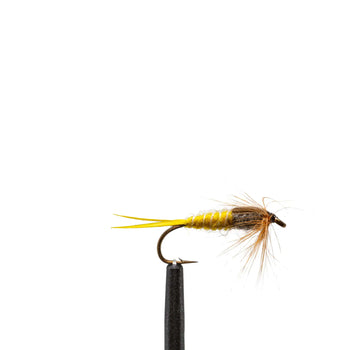
Stonefly Nymph – Yellow (#12–#16): The pre-hatch and morning play. Tied with a yellow-tan body, brown hackle legs, and weighted underbody, this pattern matches the Isoperla nymph during the migration window before adults emerge. Fish it dead-drift along bank-side seams in the morning, or as the point fly on a two-fly nymph rig with a smaller mayfly nymph trailing behind. Also productive throughout the day on rivers where Sallies haven't started hatching yet but the fish know they're coming.
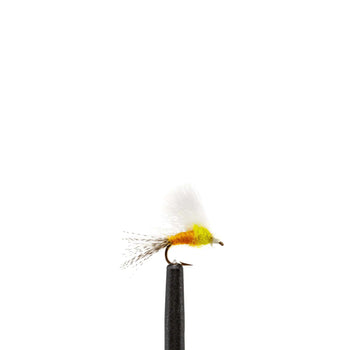
Yellow Sally CDC Emerger (#14–#16): The editorial centerpiece of this lineup. The CDC wing post and trailing shuck imitate a Sally that hasn't fully emerged from its nymphal case — the stage fish key on hardest when the hatch is active. Treat only the wing post with floatant; let the body sit flush in the surface film where natural cripples ride. Fish it solo on 5X or 6X tippet through confirmed risers refusing surface duns, or trail it behind a buoyant adult pattern as part of a dry-dropper rig. If you buy one new pattern from this post, this is it.
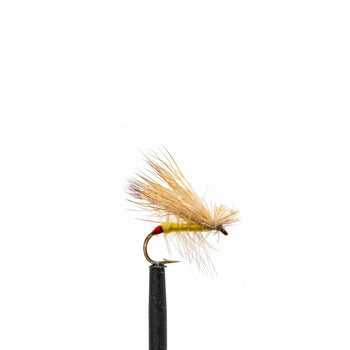
Yellow Sally (#14–#16): The standard adult dry. Pale yellow body, dun or grizzly hackle, single tail — the classic silhouette that's been catching Yellow Sally fish for sixty years. Fish it dead-drift through riffles and pocket water, then add a deliberate twitch as the fly approaches likely lies. The twitch is the trigger. On peak hatches with fish openly rising to duns, this is the fly to tie on first.
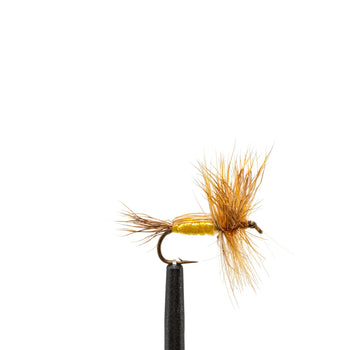
Yellow Humpy (#12–#16): The traditional hackled attractor with the deer hair wing and yellow body — Jack Horner's 1940s pattern that turned out to be one of the most productive Sally imitations ever tied. Floats higher than the standard Yellow Sally, which matters in broken pocket water and fast riffles where visibility is critical. Also produces well as a searching pattern through Sally water when no specific hatch is on. The Humpy is what to fish when the standard Yellow Sally is getting drowned by current.
 |
|
|
 |
| Foam Stimulator – Yellow | Chubby Chernobyl – Pale Yellow (PIMP) | Water Walker – Gold | Madam X |
Foam & Attractor Patterns for Sally Water
When standard hackled dries get drowned by fast water or fish want a bigger silhouette during the egg-laying flight, these four patterns earn their place. All four float high, hold up to dozens of casts, and double as the visible anchor in a dry-dropper rig.
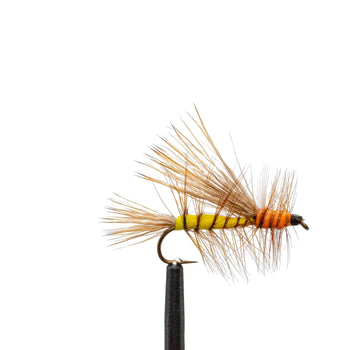
Foam Stimulator – Yellow (#12–#14): The high-visibility, high-floating adult attractor. The closed-cell foam body keeps this fly riding even after dozens of casts and grabs, which makes it the right pattern for fast pocket water and broken riffles where standard hackled patterns get waterlogged. Also the ideal dry-dropper anchor — it'll support a heavy beadhead nymph or an emerger without sinking. Fish it through the heaviest water you can find during peak Sally activity and trust that it'll stay up.
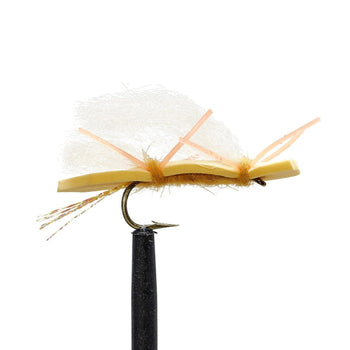
Chubby Chernobyl – Pale Yellow (PIMP) (#10–#14): The big foam attractor for when fish want a bigger silhouette than a true Sally imitation. Particularly effective during the egg-laying flight in the afternoon, when female Sallies are bouncing on the surface and fish are looking for movement and bulk. Also the right choice when you're searching unfamiliar water during what should be Sally time — the Chubby produces strikes whether or not specific Sally activity is on. The white wing post is built for visibility in glare and broken water.
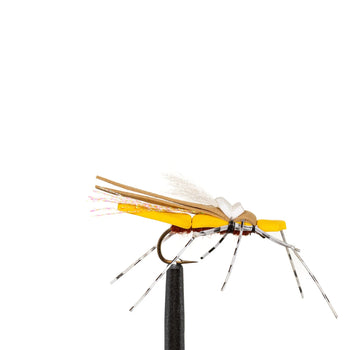
Water Walker – Gold (#10–#14): A more realistic foam adult than the Chubby — closer to the silhouette and proportions of a real Yellow Sally or small golden stone. The Water Walker rides well, floats high in the broken water Sallies prefer, and presents a more "true" insect profile for selective fish that have refused larger attractors. Particularly useful in the late afternoon on pressured water where fish have seen too many Chubbys.
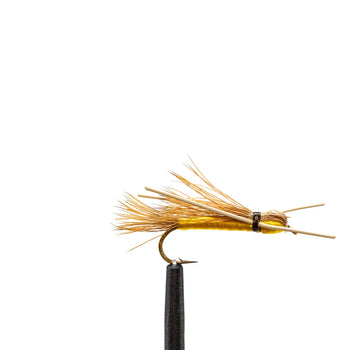
Madam X (#10–#14): The classic hair-bodied attractor with rubber legs. Not a Sally imitation in any strict sense, but a remarkably productive pattern in Sally water because the rubber legs imitate the kicking motion of an egg-laying female or a struggling adult. Fish it dead-drift through fast water and add a slight twitch to activate the legs. Also one of the best patterns to fish on a windy afternoon when natural drift is impossible — the silhouette and movement are what trigger strikes, not the perfectly natural presentation.

Taking It to the Water
The Yellow Sally is one of the most consistent and most under-fished hatches in American fly fishing. It happens daily for six to eight weeks on every wild trout watershed in the country, from June through early August. It triggers aggressive surface feeding by fish that are otherwise nymphing the bottom. It rewards anglers who pay attention to stage, water type, and motion — and it frustrates anglers who fish it like a mayfly.
The fix is not complicated. Carry patterns that cover all four stages of the hatch. Watch the water before you tie on a fly — adults visible, swirls below the surface, fish in the riffles or in the soft water nearby. Match what you see to the right stage, not the most photogenic dry in your box. Then present it with motion. Twitch the adult. Skate the egg-layer. Trust the emerger when fish refuse the dun.
Do those things and you'll find that the Yellow Sally hatch is not unreliable. It's just been mis-read.
Yellow Sallies are also a small piece of the broader stonefly family — if you missed our family-level breakdown earlier this spring, the May Stoneflies Fly of the Month covers everything from Salmonflies to Skwalas to the Little Yellow Sallies featured here, and it's the right primer if you want to understand how the entire stonefly cycle works across the season.
The rivers are open. The Sallies are hatching. Go read the water.
Related Articles
- Late Spring to Early Summer Fly Fishing: A Regional Hatch Guide for Every Major Watershed
- Match the Spring Hatch: Top 10 May Hatches Every Fly Angler Should Know
- Stoneflies: Fly of the Month — May 2026
- Read the Rise: How to Decode a Caddis Hatch in Real Time
- The Two-Fly Rig That Covers Every Hatch
- Fly of the Month Archive


