

How to Cast a Fly Rod: A Beginner's Guide

If you've ever watched someone fly fish — really watched — you've seen the thing that sets it apart. The line moves through the air in long, unhurried loops, back and then forward, and settles onto the water almost without sound. It looks like something that takes years to learn.
Some of it does. But the part that actually puts a fly in front of a fish is learnable in an afternoon, and most people are catching trout long before their cast looks like the one in the video.
Fly fishing is built around a single idea: trout eat insects, and insects weigh almost nothing. To fool a fish, you have to offer it something that weighs almost nothing too — a few wraps of thread and feather on a small hook, tied to imitate a mayfly or a caddis or a grasshopper that fell in the water. That's what a fly is, and it's why the sport works the way it does.
It also creates the central problem. There's nothing there to throw.
So fly fishing puts the weight somewhere else — in the line. A fly line is thick, heavy, and coated, and it's what carries the energy of your cast. You're not throwing the fly at all. You're throwing the line, and the fly comes along at the end of it. Understanding that one inversion explains nearly everything that feels strange about fly casting, including why muscling it makes things worse rather than better.
Casting is the skill the rest of the sport rests on. You can own the right rod, tie on exactly the right fly, and stand in water full of trout — and none of it matters if you can't put the fly where the fish is. A good cast buys you accuracy, so you can drop a fly into a spot the size of a dinner plate. It buys you a soft landing, so the fish doesn't bolt. And it buys you access to water you'd otherwise have to walk past.
The good news is that the basic cast is not hard. Most people can put a fly thirty feet away, accurately enough to catch fish, after an afternoon on a lawn. This guide covers that cast step by step, two variations that solve the situations where it won't work, how to read your own line to see what you're doing wrong, and the handful of mistakes behind nearly every beginner's frustration.
No jargon you don't need, and nothing you can't practice in a park.
Before You Cast
Practice on grass, not water. A lawn, a park, an empty parking lot — anywhere with room behind you and nothing to hook. Cut the fly off and tie a small piece of bright yarn to your tippet instead. You'll see exactly where your fly would have landed, you can't hook yourself, and you're not spooking fish while you learn.
Start with about twenty feet of line out past the rod tip. Beginners almost always start with too much. Twenty feet is enough to load the rod and see what your loop is doing, and short enough that mistakes are obvious rather than mysterious. You can lengthen later.
Your rod needs to be rigged and balanced before any of this matters. A 5-weight line on a 5-weight rod, a leader that tapers properly, everything seated. If you're not sure yours is set up right, walk through How to Rig Your Fly Rod first — a mismatched setup makes casting feel impossible for reasons you'll never diagnose from the casting side.
The Overhead Cast
This is the cast. Everything else in fly fishing is a variation on it, and if you learn nothing else you can fish almost anywhere.
Start with the grip. Hold the cork like you'd hold a hammer, with your thumb on top of the grip pointing toward the rod tip. Firm, not clenched — a tight grip locks your wrist and kills the feel you need. Your thumb is doing more than holding on; it's your alignment reference, and where it points at the end of the stroke is roughly where the line goes.
Square up to your target with your feet about shoulder width apart. If you're right-handed, dropping your right foot back slightly opens your shoulders and makes it easier to watch your back cast — which you should do, at least while you're learning. Most beginners never look behind them and never find out what's going wrong back there.
Begin with the rod tip low and the line straight out in front of you. Slack line is the enemy of a good start. If the line is piled or curved, the first part of your stroke gets spent just straightening it out, and the rod never loads. Strip in until it's taut against the water or grass.
Now the stroke itself, which is two motions separated by a pause.
The back cast: accelerate the rod smoothly upward and backward, and then stop — abruptly — when your hand is roughly beside your ear and the rod is standing near vertical. That stop is not incidental. It's the whole thing. The sudden halt is what transfers energy from the rod into the line and forms the loop. A gradual slowdown produces a wide, sloppy loop that carries no energy.
The pause: wait. The line needs time to unroll behind you and straighten. How long depends on how much line you have out — more line, longer pause — which is why this can't be taught as a count. You have to feel it, and the feel is a slight tug as the line comes tight. If you start forward before that happens, you'll hear a crack like a whip. That sound is your fly snapping off.
The forward cast: accelerate smoothly forward and stop just as abruptly, with the rod tip ending high — pointed at a spot slightly above your target rather than down at the water. The line unrolls forward, straightens, and settles. Only then do you lower the rod tip to follow it down.

One note on the clock, since it trips people up. The arc describes where the rod points at each stage — not the path the rod tip carves through the air. The tip itself should travel nearly straight during the acceleration. Ten and two are also a starting reference rather than a rule; as you get more line out, the stroke opens up and both stops drift back a little. Learn the timing with a short line and the angles will sort themselves out.
📌 Pro Tip: The pause is the part everyone gets wrong, and it's the part that fixes everything else. If your casts are piling up, your loops are collapsing, or you keep hearing that whip-crack — pause longer. It will feel excessive. It usually isn't.
Reading Your Loop
The shape of the line as it unrolls tells you exactly what your stroke did wrong, which makes it the most useful feedback in fly fishing. You don't need an instructor watching you; you just need to turn your head and look.
A tight loop is narrow and candy-cane shaped, with the top and bottom legs of the line running close and parallel. It cuts through air, holds its energy, and turns over cleanly. This is what you want, and it comes from a straight rod tip path and a crisp stop.
A wide, open loop is the same shape with the two legs far apart. It loses energy fast, gets pushed around by wind, and often fails to straighten the leader. The cause is almost always too much wrist — the rod tip traveled in an arc instead of a straight line, usually because the stroke got long and sweeping.
A tailing loop is the one that produces knots. Look for the point where the two legs actually cross each other — the fly leg dips and passes through the rod leg — and that crossing is where a wind knot ends up in your leader. It comes from applying power too early or too abruptly in the middle of the stroke instead of building it smoothly toward the stop. The fix is counterintuitive: start slower and finish harder.

Technique Two: The Roll Cast
The roll cast exists because the overhead cast needs room behind you, and rivers rarely provide it. Willows at your back, a cut bank, a canyon wall, standing chest-deep against brush — this is the cast that lets you fish those places, and it's the one most beginners are glad to learn second.
It has no back cast at all. Instead, you use the water's grip on your line to load the rod.
Draw the rod slowly back and up until your hand is near your ear and the rod is tilted slightly outward, away from your body. Move slowly — you're not casting yet, just repositioning. The line should slide toward you across the surface and hang in a curve, or "D loop," from the rod tip down behind your shoulder.
Pause for a beat and let that curve settle. Some of your line stays on the water in front of you, and that's intentional — the tension between the water and the line is what loads the rod when you come forward.
Drive the rod forward and down with a crisp stop, exactly like the forward half of an overhead cast. The line rolls out across the surface in a loop and straightens in front of you.
It won't reach as far as an overhead cast and it's less delicate on the presentation. It doesn't need to be either of those things. It needs to put a fly in front of a fish in a place you otherwise couldn't fish at all.
📌 Pro Tip: The roll cast only works if the line has something to grip. On grass it barely functions, and on very slick water it's weaker than on a broken surface. Practice this one on the river rather than the lawn.
Technique Three: The Sidearm Cast
Same stroke, rotated. Instead of the rod traveling in a vertical plane beside your ear, tip it over so it sweeps closer to horizontal — anywhere from forty-five degrees to nearly parallel with the water.
Three situations make this the right choice. Overhanging branches that would catch a vertical back cast. Wind, because a low cast stays under the worst of it and keeps your line from being pushed around. And spooky fish in flat water, where a rod waving overhead is a visible threat and a lower profile isn't.
The mechanics don't change. Same acceleration, same abrupt stop, same pause between back and forward. The only difference is the plane you're working in, which means once your overhead cast is solid you already know how to do this.
One safety note that matters: a sidearm cast travels through the space beside you at roughly hook height. Look before you start, and be certain of where everyone else is.
What Usually Goes Wrong
Too much wrist. This is the most common problem by a wide margin. A loose wrist turns a straight rod tip path into a big arc, which opens your loop and drains the energy out of it. The cast should be driven by your forearm and shoulder, with the wrist held nearly firm — a small amount of hinge at the very end of the stroke, not a flick. If you can't feel the difference, tuck the rod butt inside your shirt cuff or against your forearm; it makes the wrist break impossible to ignore.
Rushing the pause. Second most common, and the source of that whip-crack sound. You're starting the forward cast before the line has straightened behind you, so instead of loading the rod you're just yanking a slack line. Watch your back cast until the timing becomes automatic.
Trying to power through it. Fly casting rewards smoothness in a way that feels wrong to anyone who's played a throwing sport. Force produces wide loops, tailing loops, and fatigue. If your cast isn't reaching, the answer is almost never more effort — it's a crisper stop, a longer pause, or less line out.
Too much line, too soon. Thirty feet of line handled well beats sixty feet handled badly, and the overwhelming majority of trout are caught inside thirty feet anyway. Get short casts clean before you start reaching.
Endless false casting. False casting has real uses — drying a fly, changing direction, measuring distance. But every extra stroke is another chance to spook a fish, catch a branch, or lose your timing. Two false casts and deliver.
📌 Pro Tip: Film yourself casting from the side with a phone propped on a bag. Ten seconds of video will show you a wrist break or a rounded rod tip path that you genuinely cannot feel while you're doing it.
How to Practice
Short sessions beat long ones. Fifteen minutes of deliberate practice several times a week builds the motion far faster than an occasional hour, because casting is a timing skill and timing degrades with fatigue. Once your arm gets tired, you start muscling it, and you're practicing the wrong thing.
Give yourself a target. A paper plate, a hula hoop, a hat on the grass. Casting at nothing in particular builds a stroke; casting at something builds a stroke you can aim. Start at twenty feet, hit the target consistently, then move back.
Practice the roll cast on real water, since it needs surface tension to work. And spend a little time casting from your knees, or sitting, or with your off hand — awkward positions are exactly what a real river will ask of you.
What You're Casting With
Casting is mostly technique, but the gear sets a floor on how well technique can express itself. A line that doesn't match the rod, or a leader that won't turn over, makes a good stroke look bad.
 |
 |
 |
 |
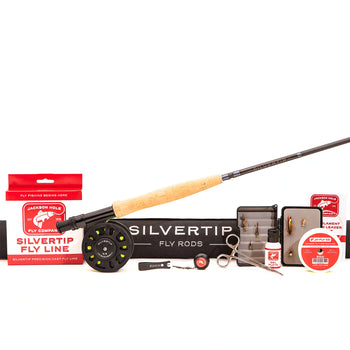
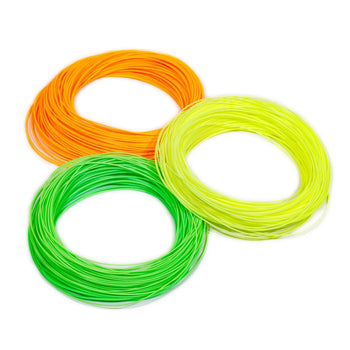
| Crystal Creek Combo Kit | Silvertip Fly Rod | Weight Forward Fly Line | Tapered Leader — 3 Pack |
The Crystal Creek Combo arrives matched and pre-spooled, which removes the most common cause of casting trouble before you ever pick the rod up. The Silvertip 9'0" is a medium action — it loads at short range and gives you more feedback than a fast rod, which is exactly what you want while you're learning the timing. A weight-forward floating line puts mass near the front so the rod loads early and easily. And a tapered leader is what transfers energy from the fat line down to the fly; a level piece of mono will simply dump in a pile no matter how well you cast.
Where to Go From Here
The overhead cast, the roll cast, and a sidearm variation will cover you almost anywhere you fish. That's not a beginner's consolation — plenty of experienced anglers spend entire seasons using nothing else.
Once the motion stops requiring your full attention, the next thing worth learning isn't a longer cast. It's mending — controlling the line after it lands so your fly drifts naturally instead of being dragged across the current. Mending will catch you more fish than another ten feet of distance ever will.
And knowing where to aim matters more than either. Reading Water 101 covers how to look at a river and find the places trout actually hold.
When you're ready to push distance, accuracy, and casting in difficult conditions, Cast Like a Pro picks up where this leaves off — double hauls, reach casts, and line control at range.
For now: get on the grass, put twenty feet out, and pause longer than feels right.
Related Articles
- How to Rig Your Fly Rod: A Complete Beginner's Guide
- Reading Water 101: Where Trout Actually Hold
- Cast Like a Pro: The Ultimate Guide to Precision, Power, and Presentation
- Master Your Drift: Mending Techniques for Natural Fly Presentation
- Fall Casting Tips: Master the Basics for Success
- Why a 5WT Is the Most Versatile Rod in Fly Fishing
- Starting Your Fly Fishing Journey: A Beginner's Guide
- Browse All Beginner's Guides →


