

Fall Fly Casting: Wind, Low Water and Weighted Flies

The cast that worked fine in July starts failing in October, and usually not because anything went wrong with your stroke.
The wind came up. The water dropped and cleared, so fish that ignored a sloppy delivery in June now leave before your fly lands. And the fly on the end of your leader went from a size 16 dry that weighed nothing to a weighted streamer or a two-nymph rig with split shot, which turns over about as gracefully as a set of keys.
None of that calls for new casts. It calls for understanding what those three conditions do to the cast you already have. If you're still building that cast, start with How to Cast a Fly Rod and come back — everything below assumes the overhead and roll casts are already working on a calm day.
A Few Terms, Up Front
- Loop – The shape the line makes as it unrolls. A tight, narrow loop cuts wind; a wide, open one doesn't.
- Turnover – The leader straightening at the end of the cast so the fly lands out ahead of it rather than in a pile.
- Wind knot – The overhand knot that appears in your leader out of nowhere. Usually caused by a tailing loop rather than by wind, and it cuts your tippet strength badly.
- Slack-line presentation – Any cast that puts deliberate slack in the leader so the fly drifts before the current can drag it.
- Reach cast – Laying the rod over to one side as the line unrolls, placing the line upstream of the fly before it lands.
- Tuck cast – A hard, high stop that makes a weighted fly dive under the leader, so it sinks immediately instead of sailing downstream first.
- Redd – A spawning bed: a patch of gravel a fish has fanned clean, so it looks noticeably paler than the streambed around it.
What Fall Actually Changes
Three things, and they stack.
Wind. Fall weather moves. Cold fronts, canyon winds in the afternoon, gusts that weren't there when you parked. Wind punishes a wide loop and nothing else about your cast matters until you deal with it.
Low, clear water. Flows drop through the fall, and what was a riffled, forgiving surface in June is now a glassy flat where a fish can see your leader, your line, and quite possibly you. The penalty for a heavy-handed delivery goes way up.
Weight on the end. Fall fishing is streamers and weighted nymph rigs. A weighted fly doesn't unroll — it swings around on the end of the leader like a pendulum, and it will hit you in the back of the head if you cast it the way you cast a dry.
Then two smaller ones that compound everything: days get short, so you're often fishing in flat low-angle light that makes your fly hard to track, and your hands get cold, which quietly ruins line handling long before you notice.
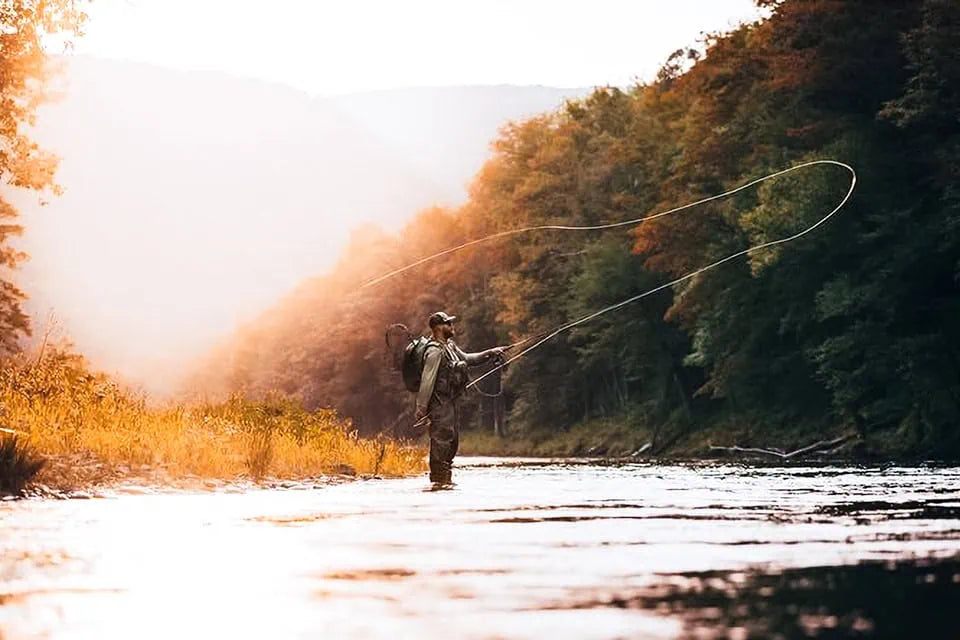
Casting Into Wind
Wind is the fall problem people complain about most and solve least, usually because the instinct is to throw harder. Throwing harder opens your loop, which gives the wind more to push on. It makes everything worse.
Tighten the Loop Before Anything Else
A narrow loop presents a thin profile to the wind and carries its energy to the end. You get one by keeping the rod tip traveling in a straight line and stopping it crisply — the same thing that makes a good loop on a calm day, just mattering far more. If your loops open up under pressure, shorten the casting stroke rather than lengthening it.
Lower the Plane
Wind is slower near the water. Dropping your cast from vertical toward sidearm puts the line in that slower air and keeps it from being pushed around. You lose a little height and gain a lot of control, which is almost always the right trade in a breeze.
Let the Wind Do the Work on One End
A headwind that ruins your forward cast is a tailwind on your backcast, and the reverse. So aim high on the cast the wind is helping and drive low and hard on the cast it's fighting. Into a headwind: a high, open backcast and a low, tight forward cast. With the wind behind you: a low, firm backcast and a high forward cast you let the wind carry.
📌 Pro Tip: In a hard headwind, turn around. Make your presentation on what would normally be your backcast — it's a more powerful stroke for most people, and you'll deliver into wind far better facing away from the target and letting the line go behind you.
The Crosswind Safety Problem
A crosswind blowing from your casting-arm side pushes the line and the fly across your body. At best it wrecks the cast; at worst it buries a hook in your ear or the back of your neck, and that is genuinely how most people get hooked.
Two fixes. Tilt the rod over and cast on the downwind side of your body, or cast with the rod angled across to your other shoulder so the line travels on the safe side. Either way, put the line downwind of you. And wear eye protection in the fall whether or not it's windy.
Low, Clear Water Wants a Softer Delivery
By October the river is often at its lowest and clearest of the year. Fish that sat in broken water all summer are now in smooth glides where they can study everything, and a cast that lands hard sends them to the far bank.
Lengthen the leader. Going from nine feet to twelve puts more distance between the thick fly line and the fly, and a longer, finer front end lands softer on its own. It's the single easiest change you can make.
Aim above the water, not at it. Stop the rod with the tip high and let the line straighten in the air so the fly settles down onto the surface. Casting at the water drives everything down and lands with a slap.
Put slack where you need it. A reach cast — laying the rod over to the upstream side as the line unrolls — lands the line upstream of the fly and buys you several feet of drag-free drift before you have to mend. In flat water that's worth more than distance.
Fish closer. Low water concentrates trout in fewer places, and those places are usually reachable. A controlled thirty-foot cast beats a sloppy sixty-footer in every way that matters, and the short cast is also the one you can actually mend.
📌 Pro Tip: In low water the approach matters as much as the cast. Stay low, keep off the skyline, and wade in slowly — the wake you push ahead of you travels further than your fly does. Plenty of fall fish are spooked before a line ever touches the water.
Weighted Flies Change the Timing
This is the adjustment that catches people out, because it contradicts what you learned about good casting.
A weighted streamer or a nymph rig with split shot does not unroll in a loop. It hinges — the weight swings around the end of the leader on its own schedule. Try to cast it with the tight loop you use for a dry fly and the fly will collide with your leader, tangle, or hit your rod.
Open the loop on purpose. A wider casting arc gives the weight room to travel without crossing paths with the line. This is the one situation where a wide loop is correct, and it's worth saying plainly because it feels like a mistake.
Slow everything down and wait longer. A heavy rig takes noticeably more time to straighten behind you. Count it out if you need to — the pause that feels excessive is usually about right, and most tangles are a forward cast started too early.
Stop false casting. Every extra stroke with weight on the line is another chance to tangle, hook yourself, or lose the rhythm. Pick the line up, make one backcast, and deliver.
Use a tuck cast to get down fast. A hard, high stop makes a weighted fly tuck under the leader and dive on landing. In a short pocket where you only have a few feet of drift, that head start is the whole difference between reaching the fish and drifting over it.
📌 Pro Tip: If you're fishing a two-fly rig with shot and it tangles every third cast, the problem usually isn't your casting — it's the rig. Shorten the distance between flies, move the shot, or drop to one fly. A simpler rig you can cast cleanly out-fishes a clever one you spend the afternoon untangling.
Short Days and Low Sun
By late fall the sun never gets far above the canyon rim, and that creates two casting problems that have nothing to do with technique.
You can't see your fly. Low-angle light throws glare across the water and flattens everything. Move so the sun is behind you rather than in front, or position yourself to get a dark bank reflected behind your drift instead of bright sky. Three steps along the bank often does more than any gear change.
The fish are in the shade. As the sun drops, trout slide into shadow lines along banks, under overhangs and behind boulders. Those are the targets worth casting to — and they're usually tight to structure, which puts accuracy ahead of distance for the rest of the afternoon.
Set a turnaround time too. The best fishing is often in the last hour of light, which is exactly when it gets hard to see your backcast and easy to put a fly into a tree you can no longer make out.
Cold Hands, Clumsy Line
Nobody writes about this and everybody deals with it. Cold fingers can't feel the line, which means you shoot line badly, miss the haul, and drop loops at your feet that catch on everything.
Fingerless or convertible gloves keep enough dexterity for line handling. Keep a dry towel clipped where you can reach it, because wet hands in moving air get cold several times faster than dry ones. And simplify your rig before your hands go — retying a size 20 dropper with numb fingers in failing light is how good afternoons end early.
Where Not to Cast
Brown and brook trout spawn in fall. A redd is a patch of gravel a fish has fanned clean, noticeably paler than the streambed around it, and the fish parked on it is spawning rather than feeding. Leave those fish alone, don't cast to them, and walk well around the gravel rather than through it — a boot through a redd destroys the next generation of fish in that run.
The good fishing is downstream of them anyway. Loose eggs drift into the runs below, and the trout stacked there eating them are feeding fish, fair game and usually easier to catch.
Taking It to the Water
Fall casting comes down to three adjustments, and you can make all of them without learning anything new.
Tighten the loop and drop the plane when it's windy. Lengthen the leader and aim above the water when it's low and clear. Open the loop, slow down and stop false casting when there's weight on the line.
Everything else — the glare, the cold hands, the short light — is handled by standing somewhere better and going out with a simpler rig than you think you need.
When you're ready to add distance and line control on top of all this, Cast Like a Pro covers the double haul and the reach and curve casts in depth.
SHOP FLY RODS
GEAR UP:
RELATED ARTICLES:
- How to Cast a Fly Rod: A Beginner's Guide
- Cast Like a Pro: The Ultimate Guide to Precision, Power, and Presentation
- Master Your Drift: Mending Techniques for Natural Fly Presentation
- 10 Fall Fly Fishing Tips for Trout That Have Seen It All
- Late-Season Nymphing: Five Rigs, Better Drifts and 20 Flies to Carry
- Master Fall Streamer Fishing: Top Flies, Gear & Pro Tips


